Facets of Lee Eng Beng
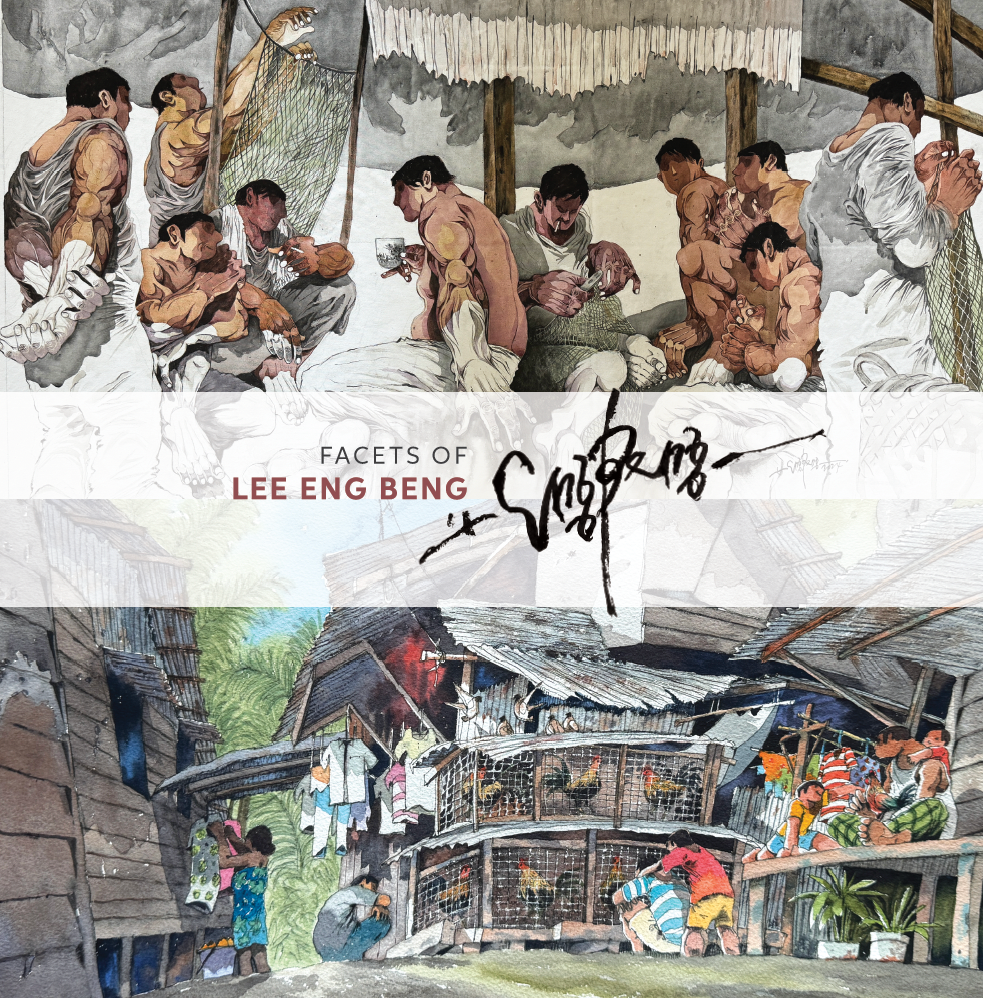
Facets of LEB follows the artistic journey of Lee Eng Beng, a Penang artist who has always been fascinated by people, places, and the rhythms of daily life. Early on, watercolour masters like Tan Choon Ghee, Koay Shao Peng, and Dong Kingman influenced him. He also found unexpected inspiration in Takehiko Inoue’s Slam Dunk, especially its striking way of showing movement.
The book highlights two main sides of Eng Beng’s painting. His acrylic works focus on people, family, and daily life, using detailed compositions and expressive shapes. His watercolours show streets, buildings, boats, and the busy scenes of city life, revealing how closely he observes the world around him. Although the mediums and styles differ, both reveal his unique perspective.
Here, we share only the introduction to Facets of LEB. This gives readers a look at the influences, experiences, and artistic ideas behind these two groups of work.
Streetscapes and figures: Confluence of movement, memories, and human connections
Contemporary artist Lee Eng Beng occupies a quiet but assured place in Malaysia’s art scene. He does not provoke or make sporadic spectacles. His art was not built on theories derived from trends in modern art; it was based on decades of sustained observation of other artists and daily life.
That, and a love of human connections, informed his work and fueled his adaptation. Indeed, the human element is deeply ingrained in his work. Whether working in watercolour or acrylic, he returns repeatedly to everyday life: people talking, resting, waiting, working, and eating; jubilant street scenes that evoke fun-filled memories; gestures that speak before words do.
Eng Beng’s body of work suggests an artist who has moved patiently through influence, discovery, and reinvention. He has arrived at a visual language that is recognisably his own.
Origins: A mother’s decision, a life redirected
Artists often trace their beginnings to early talent or dramatic moments of revelation. Eng Beng’s origin story is more modest, grounded, and perhaps more profound. The most decisive influence on his artistic life, he often says, was not an artist at all, but his mother.
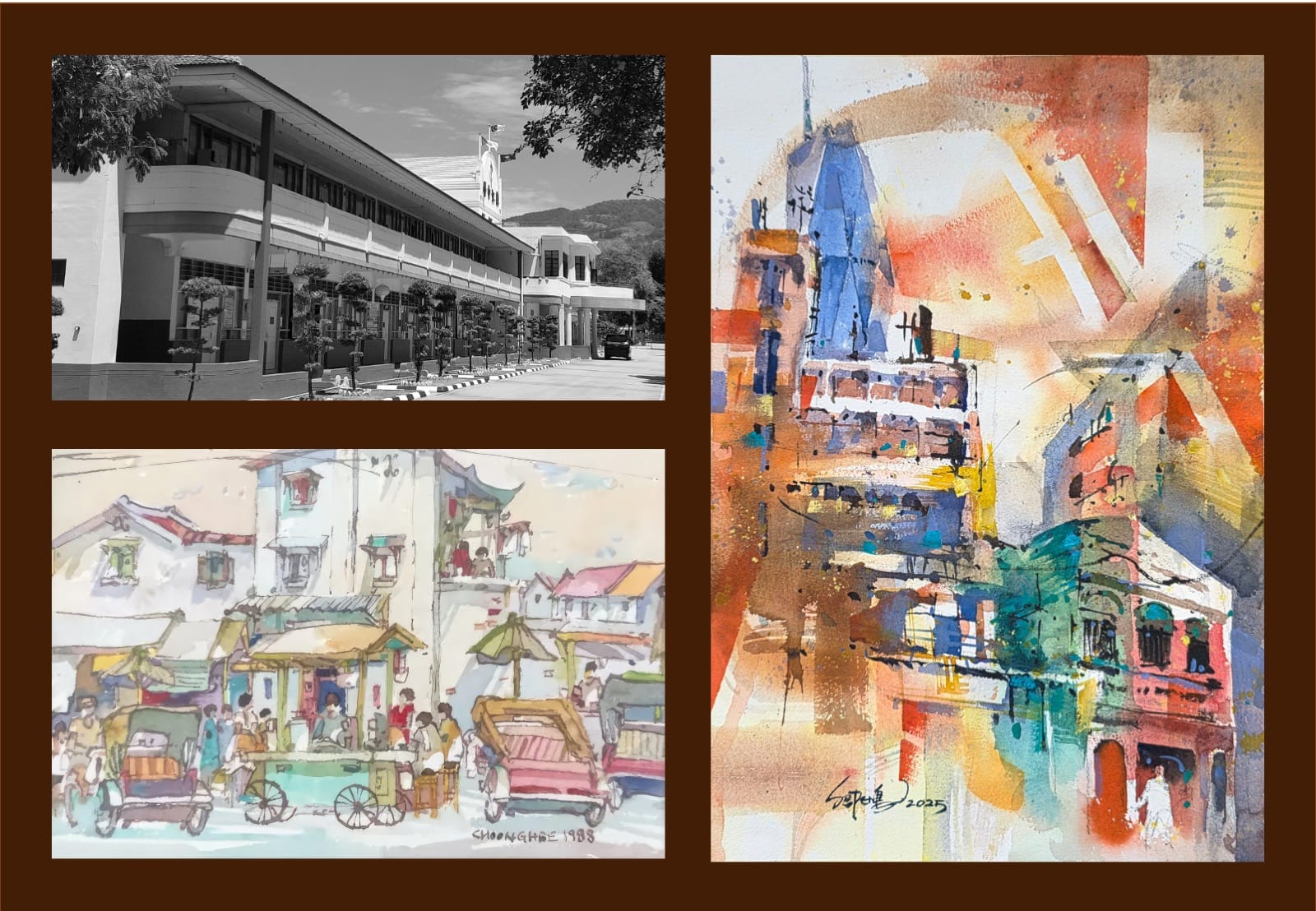
When he entered Han Chiang High School in Penang, his mother insisted that he join the school’s extracurricular art club. Her reasoning was practical rather than aesthetic: a cousin was already involved and could “keep an eye on him.” What followed was unintended. That simple decision placed him in an environment where he could explore visual art, receive mentorship, and learn from peers. It quietly shaped his life.
Under the guidance of teachers like Lau Tay Yong and senior students who took him under their wing, art ceased to be merely an activity. It became a space he felt he belonged to intimately. It also sparked an enduring curiosity in the visual arts. Looking back, Eng Beng often frames this period not as formal training, but as exposure—to ways of seeing, to discipline, to the idea that drawing and painting could structure a life.
Early professional life: Teaching, learning, and looking harder
After finishing secondary education, Eng Beng’s first job was teaching children at an art academy. This sharpened his own learning—explaining form, colour, and observation to young students forced him to articulate instincts he had previously taken for granted.
At the academy, he came under the guidance of senior figures such as Koay Shao Peng, whose influence was more about the seriousness of his approach than about stylistic direction. This was also the period when Eng Beng became deeply absorbed in watercolour, particularly in depicting urban life in Penang.
Like many artists working within a strong local tradition, he found himself drawn to an established master of the genre. Tan Choon Ghee, whose street scenes had become iconic, became his chosen model-mentor. Eng Beng painted relentlessly, studying, among others, the senior’s compositions, tonal balance, and handling of light.
The results were technically accomplished—but also slightly troubling. Word had it that Eng Beng’s work, while highly skilled, lived too closely in another’s shadow. What initially felt like an apprenticeship slowly revealed itself as a creative bottleneck. The recognition was painful but necessary. To continue along that path would be to forfeit authorship of his own voice.
Encountering Dong Kingman: Colour, economy, release
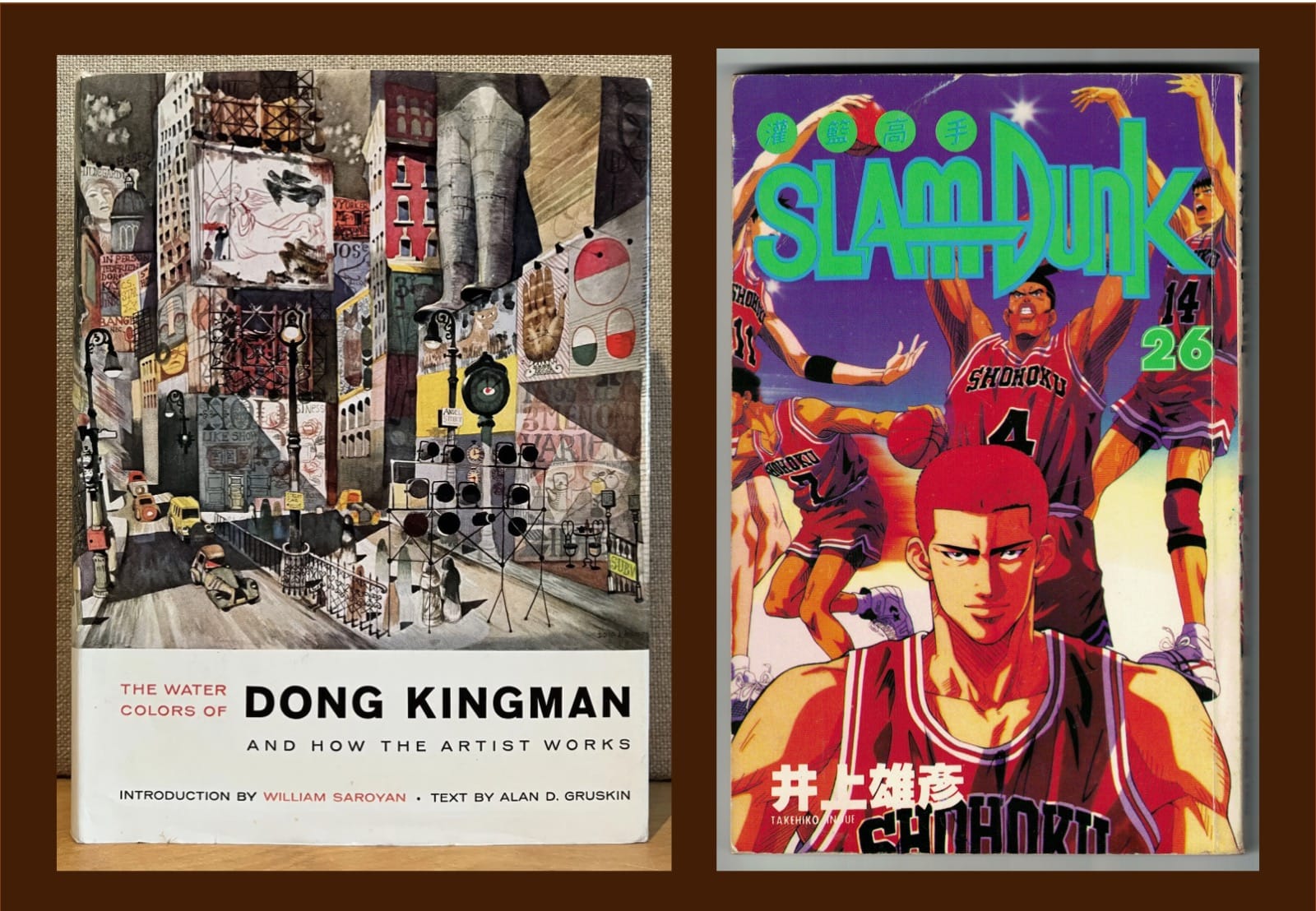
The turning point came not through critique, but through discovery. At a book fair, Eng Beng stumbled upon the work of Dong Kingman, a Chinese American painter whose watercolours of urban environments were unlike anything he had previously encountered.
This was not surprising. In the words of a famed publisher and art lover, James Saroyan: “He [Kingman] looks at New York as no one else does – as no other painter, writer, composer, photographer looks at it, and of course, New York is the world. That’s where he is. That’s where his looking at the world is steadiest. That’s where he goes to sleep, and where he wakes up.”
Eng Beng, in his own words, fell “madly in love” with this body of work. He experimented deeply, producing a series of paintings that incorporated Kingman’s daring compositional freedom and vivid colours. These works marked an important stage—not because they represented a final destination, but because they revealed something that’s essentially Eng Beng: that he is and has always been open to influences.
After more than ten paintings in this vein, he recognised another truth—even this new direction, if followed too faithfully, risked becoming another borrowed identity. With characteristic decisiveness, he stopped. With all his accumulated techniques and style, he began creating works on Penang’s heritage streets, deeply imbued with the idea of a fun-filled city.
Manga, movement, and the expressive hand
Years later, influence arrived from an unexpected direction. While teaching, a student brought a manga volume—Slam Dunk—by Takehiko Inoue to class. Eng Beng, a basketball enthusiast himself, was immediately drawn not just to the story but to the drawing.
Inoue’s genius lay in movement. Hands were strained. Fingers were splayed. Bodies were twisted mid-action. Each moment captured was charged with intention. Eng Beng began to look at the human form from a radically different perspective. Where earlier watercolours prioritised environment, he now saw the expressive potential of limbs, posture, and physical tension.
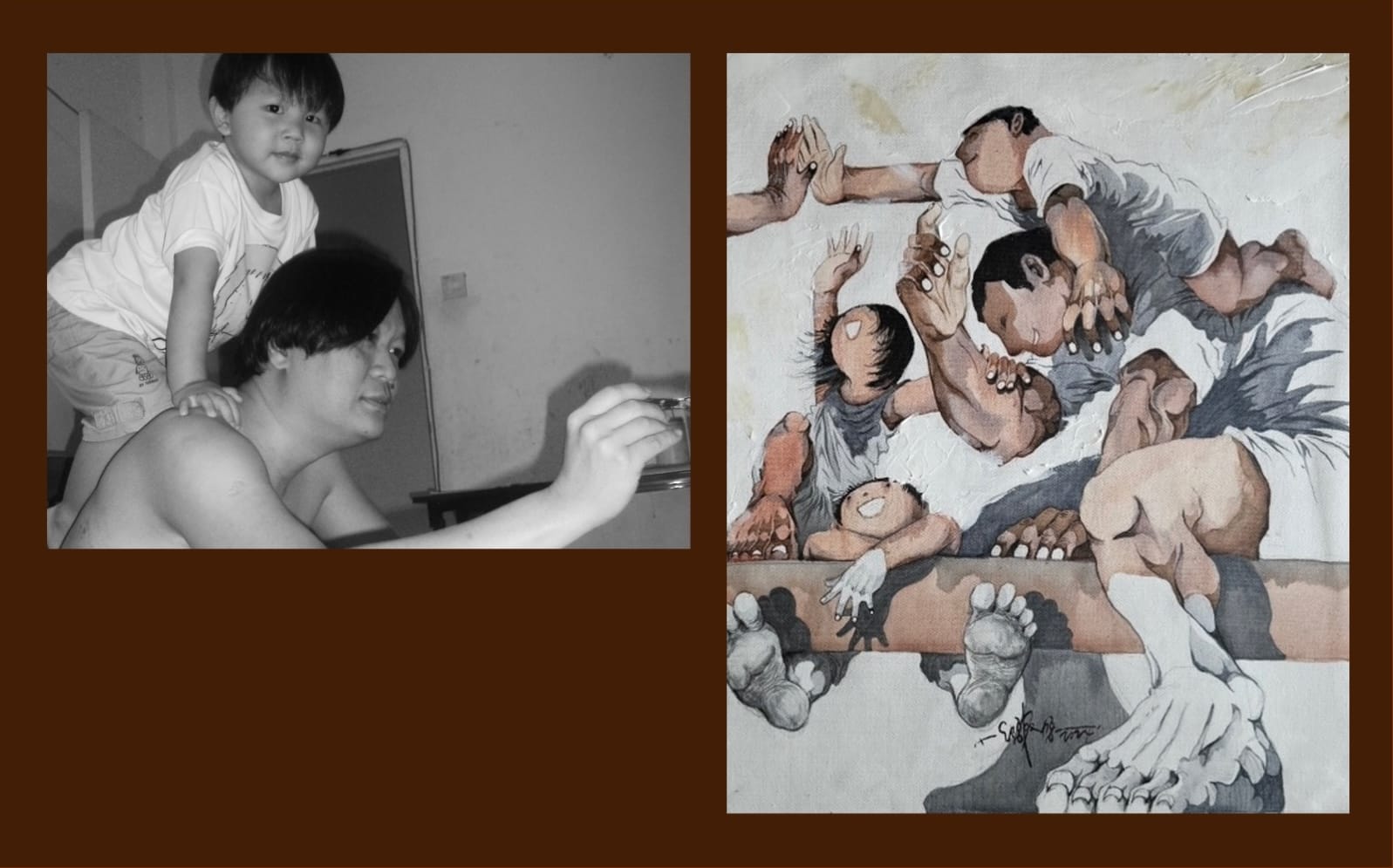
Gradually, this sensibility entered his own work. Figures became more animated; gestures more pronounced. Hands and legs, in particular, took on symbolic weight—not merely anatomical features, but carriers of emotion and labour, even a mechanism for emphasis that enhanced a composition. This emphasis would later become central to his acrylic paintings.
The acrylic revelation: A moment in Melaka
In 2007, during Malaysia’s 50th anniversary celebrations, Eng Beng was invited to participate in a series of art events in Melaka. At one such event, participants were supplied with acrylic paint. For Eng Beng, whose practice had been rooted in watercolour, this was unsettling.
Uncertain, he began tentatively—until he noticed a young Malay artist nearby using acrylics diluted heavily with water, painting freely and instinctively. In that moment, he experienced what scientists call an Eureka moment: a sudden recognition that a material could be approached differently than expected.
Back in Penang, he purchased acrylics and canvases and began experimenting with wet acrylic techniques. The shift was profound. Acrylic let him build texture, density, and physical presence in ways watercolour couldn’t. More importantly, it encouraged a conceptual shift: from place to person.
Figures, family, and the architecture of care
Eng Beng’s acrylic works are increasingly centred on human relationships—particularly male figures within domestic and communal settings. Fathers talking with sons, men gathered in casual conversation, bodies at rest yet alert. Hands and feet are exaggerated. These distortions strengthen the human form, allowing the artist to define content and meaningful expression through extreme yet controlled forms.
These paintings are not heroic in the classical sense. There are no grand gestures of warriors or gods. Instead, they represent a quieter side of masculinity, shaped by everyday bonds: friends leaning into one another, fathers teaching children, and men sharing everyday spaces like the coffeeshop or a five-foot way. The painted surfaces are textured—at times rough, at times gentle— but always worked in with deep care and intent. Skin is built up in layers, worked over, carrying the marks of touch, time, and experience.
In these works, Lee’s long engagement with movement, colour, and gesture converges. The influence of manga’s dynamism, watercolour’s sensitivity, and acrylic’s materiality coexist without strain. What emerges is not a synthesis of styles, but a consolidation of an adaptive mindset.
Continuity across media
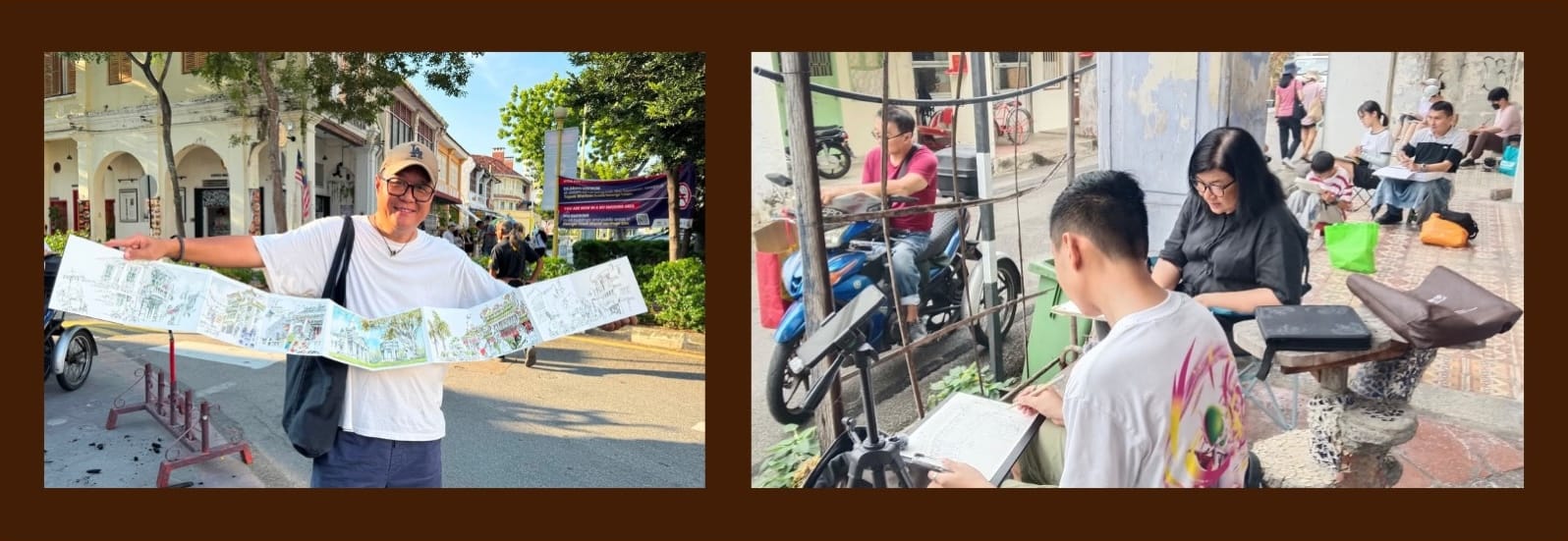
Despite the prominence of his figurative acrylic works, Eng Beng never abandoned watercolour. His urban scenes, mostly of Penang, continue as a parallel practice. He regularly participated in a group of “Urban Sketchers”, painting scenes of markets, shophouses, and iconic landmarks. Rather than representing an earlier phase, these works serve as a counterpoint: objective and jovial, rooted in a “reimagined” community of the city.
Together, the two bodies of work reveal the breadth of Eng Beng’s engagement with lived experience. One attends to the living rhythms of a World Heritage Site; the other to interpersonal bonds and traditional practices, such as playing mahjong or making a kite. Both are attended to with care and conviction.
Positioning without posture
Eng Beng’s career spans decades of exhibitions. He has a strong collector following. He is recognised across Malaysia and beyond. Yet what distinguishes him in today’s crowded art market is not how far he has pushed himself, but the credibility he has earned through self-development and, having done so, his continued faithfulness to his practice and values.
His work speaks to many people: collectors who value skill, viewers who feel its warmth, and institutions that look for culture without heavy messages. Nothing in his practice feels staged. When marketing works for Eng Beng, it simply highlights what is already there—his genuine connection with people and place.
The long view: Art as practice, not gift
Eng Beng often returns to a simple conviction: art is not innate talent bestowed at birth, but something built through years of learning and adaptation. This belief shows not only in his demeanour but also in how his career has evolved—a life built through teaching, observing, revising, and continuing.
In a time that prizes speed and novelty, Eng Beng stands for something quieter and steadier. He works as a patient witness, returning again and again to ordinary scenes until they begin to speak. His paintings show that meaning does not arrive all at once; it grows through careful, repeated looking.
Moving gently between street life and the human figure, watercolour and acrylic, influence and independence, Eng Beng has shaped a voice that is clearly his own. It does not call for attention — but it stays with you.