Moderation at the Meridian: How it evolved
IN 1974, after I read Albert Camus’ The Rebel, one paragraph became singularly important to me:
One might think that a period which, within 50 years, uproots, enslaves or kills 70 million human beings, should only, and forthwith, be condemned. But also its guilt understood. In more ingenuous times, when the tyrant razed cities for his own greater glory, when the slave chained to the conqueror’s chariot was dragged through the rejoicing streets, when enemies were thrown to wild animals in front of assembled people, before such naked crimes consciousness could be steady and judgment unclouded. But slave camps under the flag of freedom, massacres justified by philanthropy or the taste for the superhuman cripple judgment. On the day that crime puts on the apparel of innocence, through a reversal peculiar to our age, it is innocence that is called upon to justify itself.
As my university years at Kent (1973-76) and Leeds (1976-77) wore on, and as I encountered calls to join others to help change our collective lives for the better, I always returned to The Rebel. Much of the world that had undergone revolutions had turned their ideals on their heads—the Reign of Terror after the French Revolution, Stalinist Russia, Mao’s Cultural Revolution, the Vietnam War, the Killing Fields of Kampuchea…
I resisted joining groups and constantly asked: “Can we change the world and still maintain the ideals of ‘liberty, equality, and fraternity’—the timeless calls for humanity from 1789 that were so treacherously contradicted by the very people espousing them?” This practice to achieve moderation—theoretically, at least—remained elusive to me for many years. At university, I explored many “-isms” described by sociologists of knowledge, including Karl Mannheim. The closest I came was through Zygmunt Bauman, my professor at Leeds, and Jürgen Habermas, but time was not on my side. Once I left England in 1977, there was no discussant with whom to continue the discourse on this rather esoteric subject.
Left on my own, I turned to art and creativity as a path to political moderation, but to no avail. It was not until my time at ISIS Malaysia in the mid-1980s that I compiled a set of essential works by Habermas, some of which I acquired overseas. After months of laborious reading, I found the answer in his Communication and the Evolution of Society, published in 1979.
Habermas doesn’t describe the “ideal speech situation” as something that exists in everyday communication, but as a “regulative ideal”—a theoretical standard by which to critique and evaluate real communicative practices, much like Max Weber’s “ideal type” most famously used to study bureaucracy, social action and authority.
In this ideal nexus:
1. All participants have equal rights to speak, question, and challenge assertions.
2. No one is coerced—power, manipulation, and domination are absent.
3. Truthfulness, sincerity, and comprehensibility are assumed.
4. Every validity claim (truth, rightness, authenticity) can be critically examined and justified.
5. Consensus is achieved through reasoned agreement, not force or deception.
This framework is the presupposition of all meaningful communication, even if rarely realised. When we engage in argumentation, we assume good faith and openness to the better argument—this is the rational core of communicative action.
Habermas contrasts communicative action with strategic action, where interaction serves personal goals through influence or manipulation. The ideal communication nexus becomes a model of deliberative democracy, ethical discourse, and undistorted human interaction.
I had also read Zygmunt Bauman’s Socialism: The Active Utopia. He argues that socialism is not a fixed blueprint but a continuous, critical engagement with reality. As an “active utopia,” socialism pushes toward greater justice and freedom by challenging existing inequalities. Its power lies in sustaining hope—not in offering final answers—but in keeping alive the vision of a better world. For Bauman, utopia is not a perfect future state, but a critical standpoint from which to evaluate and transform the present. It suspends inevitability—the belief that current social arrangements are natural or permanent. Utopia activates the imagination, allowing us to see alternatives and demand change.
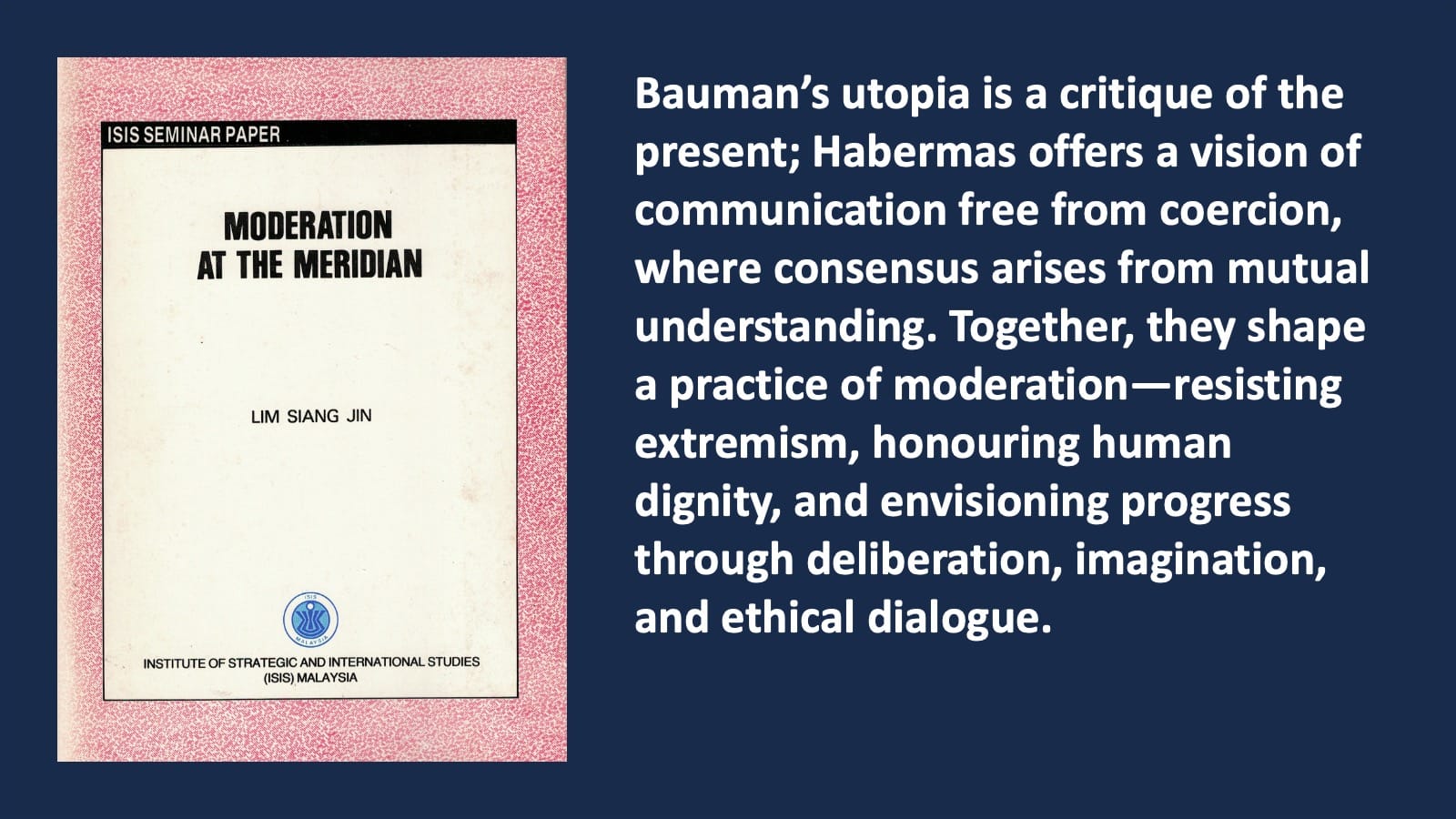
As a result, I wrote and presented an ISIS seminar paper called “Moderation at the Meridian,” combining Habermas’ thought with Bauman’s. This synthesis offers a framework for political change rooted in reason and hope. Bauman’s utopia is a critique of the present; Habermas offers a vision of communication free from coercion, where consensus arises from mutual understanding. Together, they shape a practice of moderation—resisting extremism, honouring human dignity, and envisioning progress through deliberation, imagination, and ethical dialogue.
The paper gained little traction—perhaps because it was written in a style more suited to academics. Nevertheless, the ideas stayed with me. When I had the opportunity to return to journalism in 1993, to be one of the founders of The Edge, Malaysia’s leading business weekly, I crafted its policy statement somewhat in line with these ideals:
A high standard of editorial quality and excellence should undergird success in an industry built around serving the public interest. We believe the interest of the investing public will be served by fair, accurate, and timely information.
Later, I applied these same principles to managing the company’s internal dynamics—fostering open and sincere communication at all levels. At one point, when I felt I could no longer uphold those standards, I chose to step away. Even so, the ideals continued to shape the newspaper’s culture. In 2024, on its 30th anniversary, it proudly affirmed that “trust” remains a cornerstone of its business ethos.