Wattana Wattanapun reflects on his “Women in Art”
ON NEW YEAR’S DAY 2020, just before Covid struck, I was sightseeing in Chiang Mai, visiting “non-touristy” places. It was my second visit to a city that had been etched in my memory from 1969, when I was 16. This landmark visit as a teenager was part of an itinerary our partner school in Bangkok, Triam Udom Suksa, had planned for us — a contingent of 80-plus from Penang Free School.
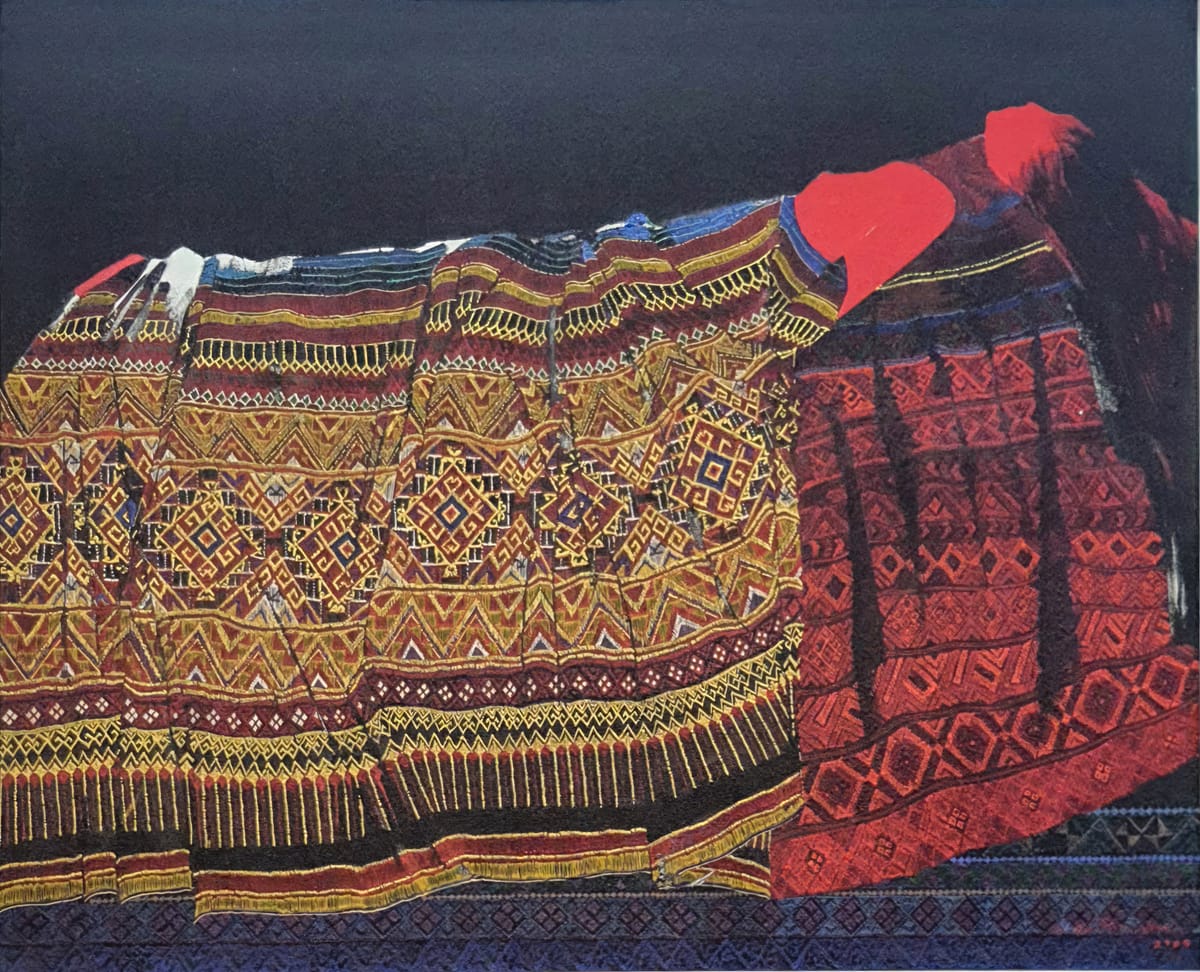
For my 2020 visit, a “famous art gallery” was on my must-see checklist. My friend and guide, Kenneth Ang, took me to one owned and run by senior artist Wattana Wattanapun. I immediately took a liking to his art—many of them feature human figures, all women, with traditional Thai fabric designs. A seamless amalgamation of the modern and the traditional, its symbolism appealed strongly to my own “sociology-of-art imagination”.
Talking to Wattana, I learned that he began as an artist in the 1960s and later studied, taught, and lived in the United States and Canada for decades before returning to Thailand and settling in Chiang Mai in 2002. He built and opened his Wattana Art Gallery on Soi Wat Umong in December 2012.
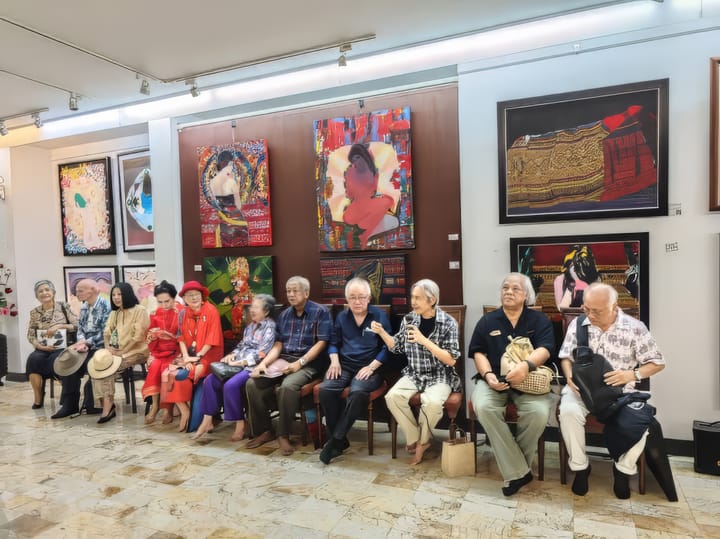
Recently, at his 85th birthday on February 20, 2026, and at the launch of his Women in Art solo at the gallery, he intimated, for the first time, why he focused on the female form and ethnic fabric design. Read here.
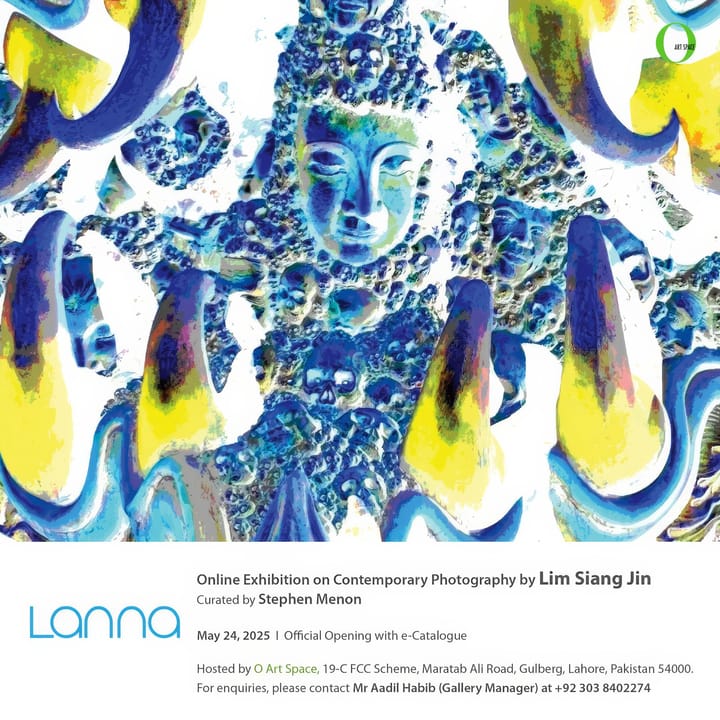
I was deeply honoured to be invited by him to showcase 12 pieces of my Lanna: Symbols in Focus—Contemporary Photographic Reflections at this duet solo, my first overseas, for which I am deeply grateful to Wattana. Read here.
Feminine form and the weaving tradition of Southeast Asia
Wattana’s interest in painting women extends beyond aesthetics. It arises from the deep historical connection between women and the making of traditional textiles. Speaking at regional conferences, he often notes that in Thai society and cultures in neighbouring countries, women have long been the traditional weavers. For example, he has spoken at the Third and Fifth ASEAN Traditional Textile Symposia. The former was held in Kuala Terengganu, Malaysia, in 2011, and the latter in Chiang Mai in 2015.
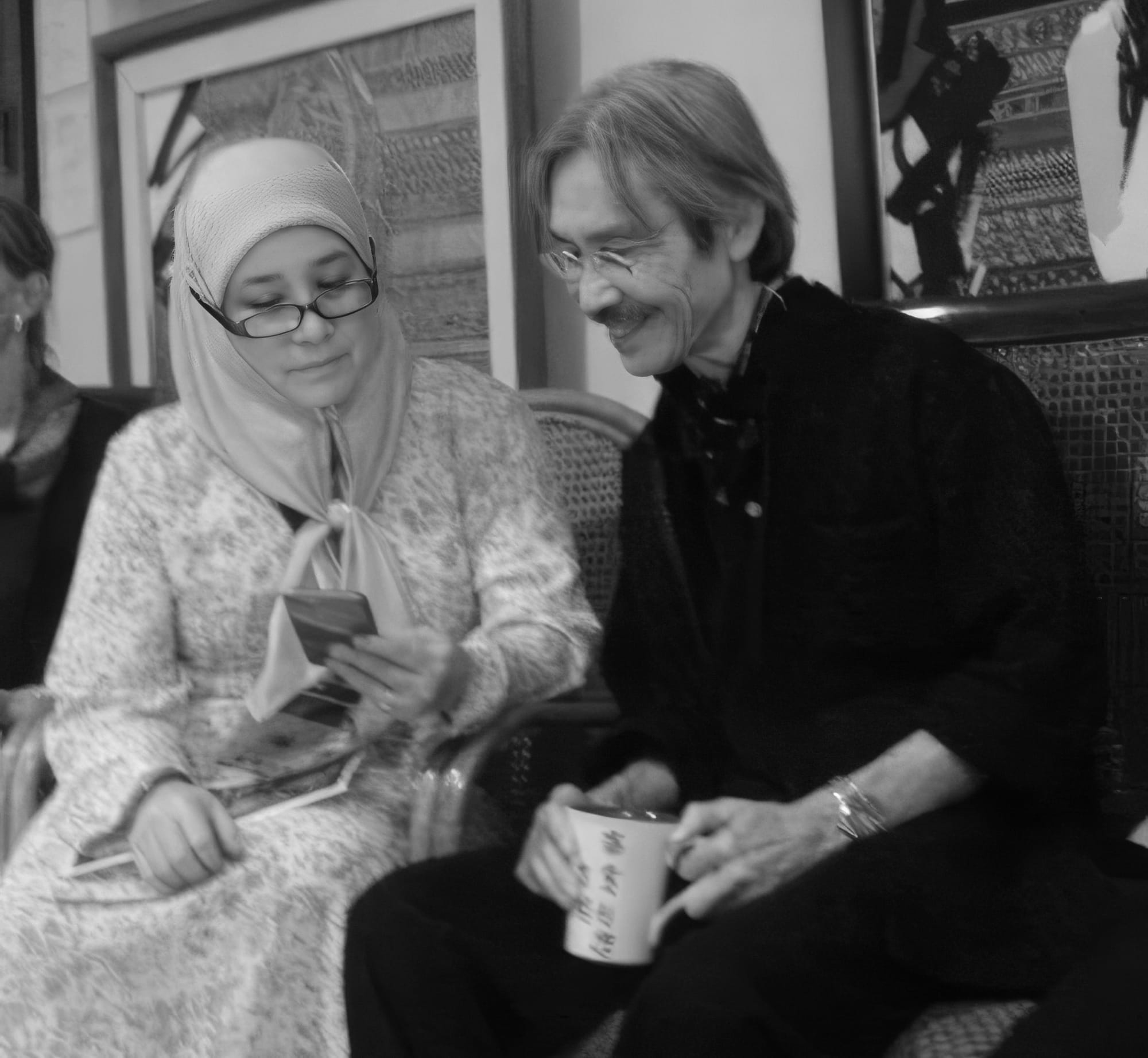
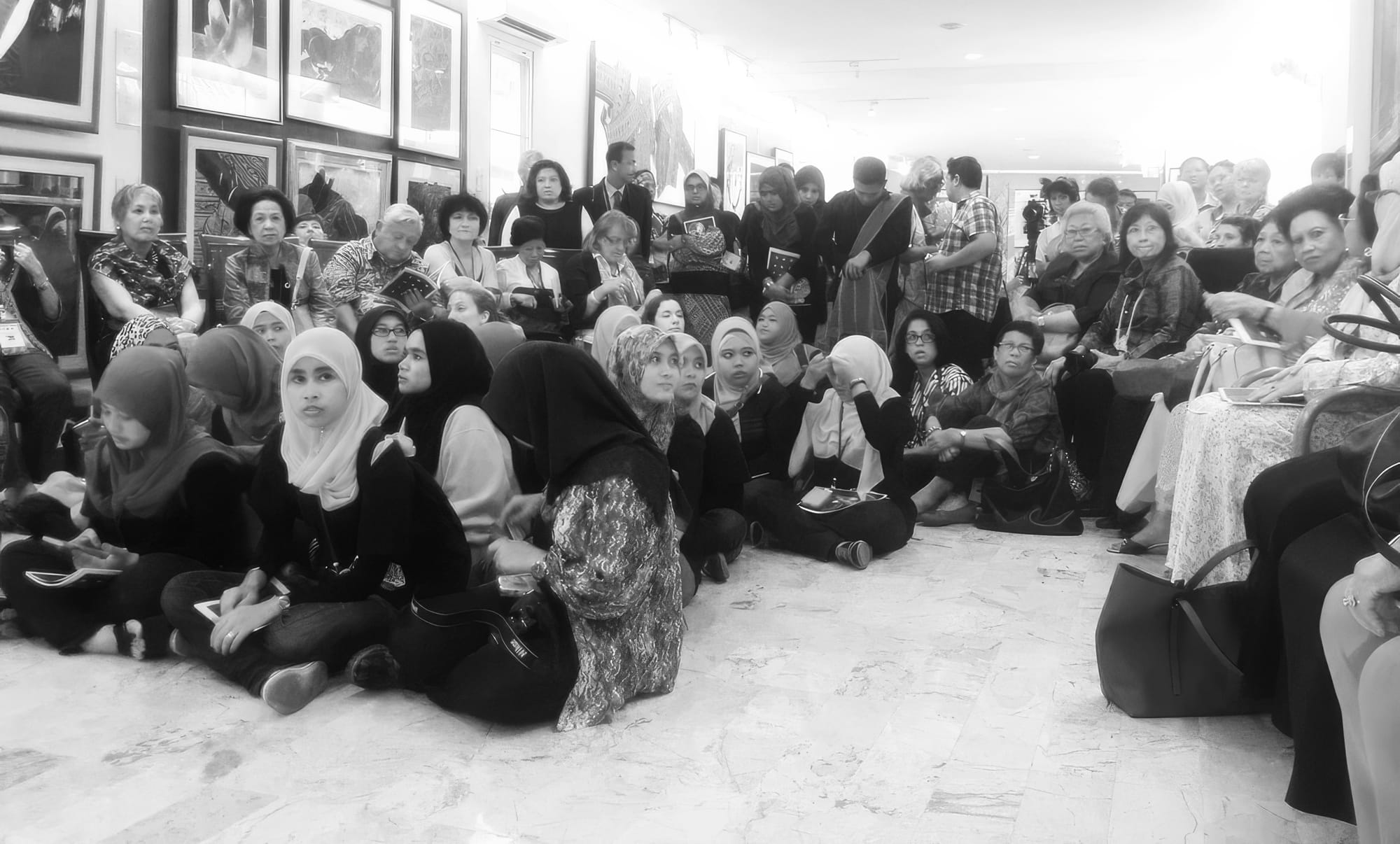
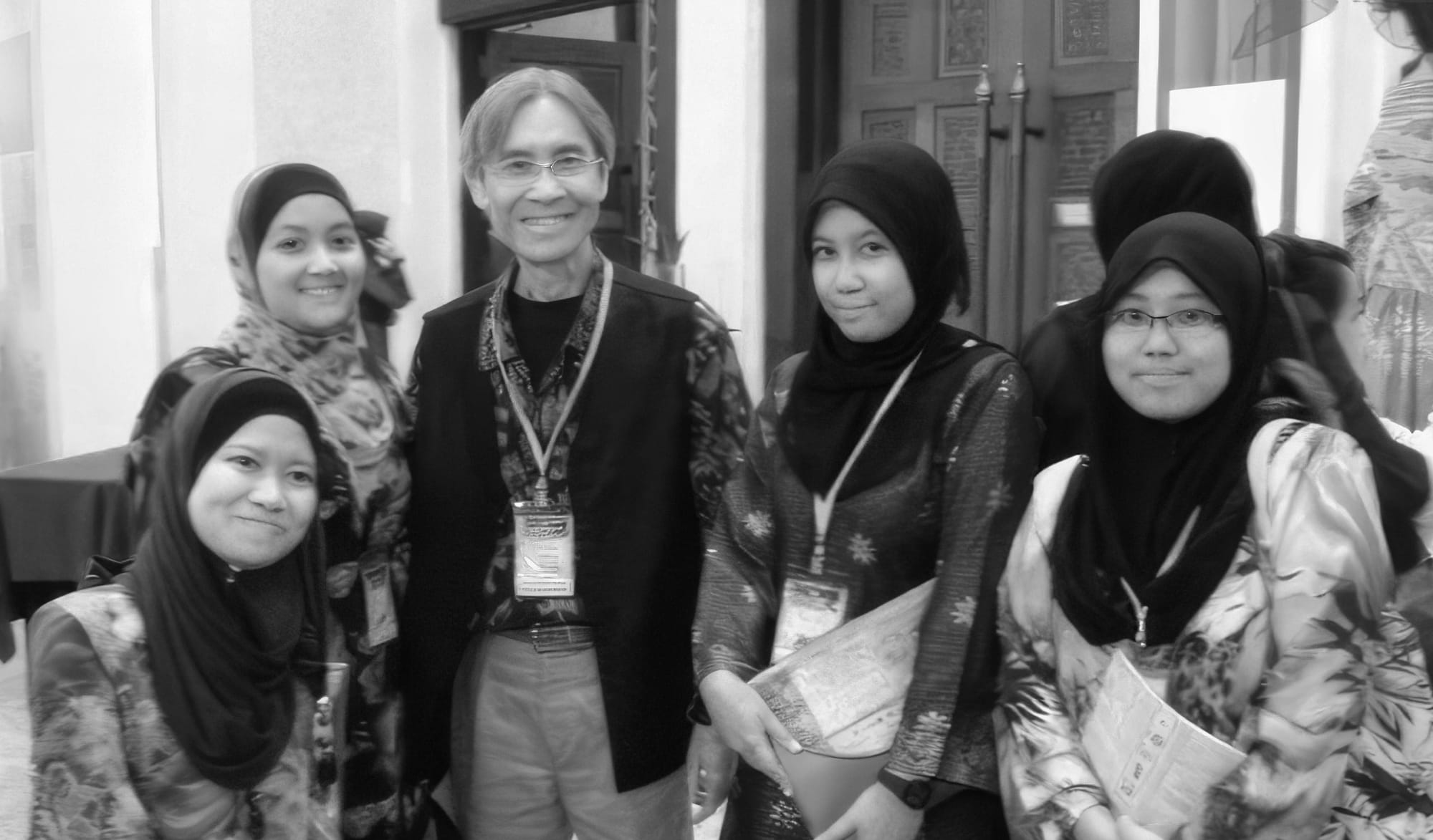
Wattana speaking to Tunku Azizah Aminah Maimunah Iskandariah, then the Tengku Puan of Pahang (left), at the Wattana Art Gallery. She and the Malaysian contingent (right), including students, were visiting Wattana as part of the Fifth ASEAN Traditional Textile Symposium held in Chiang Mai in 2015. Read more here
Including male figures, in his view, would disrupt this narrative focus. The women he paints become “weavers woven into the textile itself,” embodying those who sustain and transmit the craft tradition.
Origins of the textile series
Wattana’s interest in the intricate textures and cultural meanings of handwoven fabrics dates back to his early life, when he even learned to weave on a traditional loom. This engagement became more focused after his return from the West in 2002.
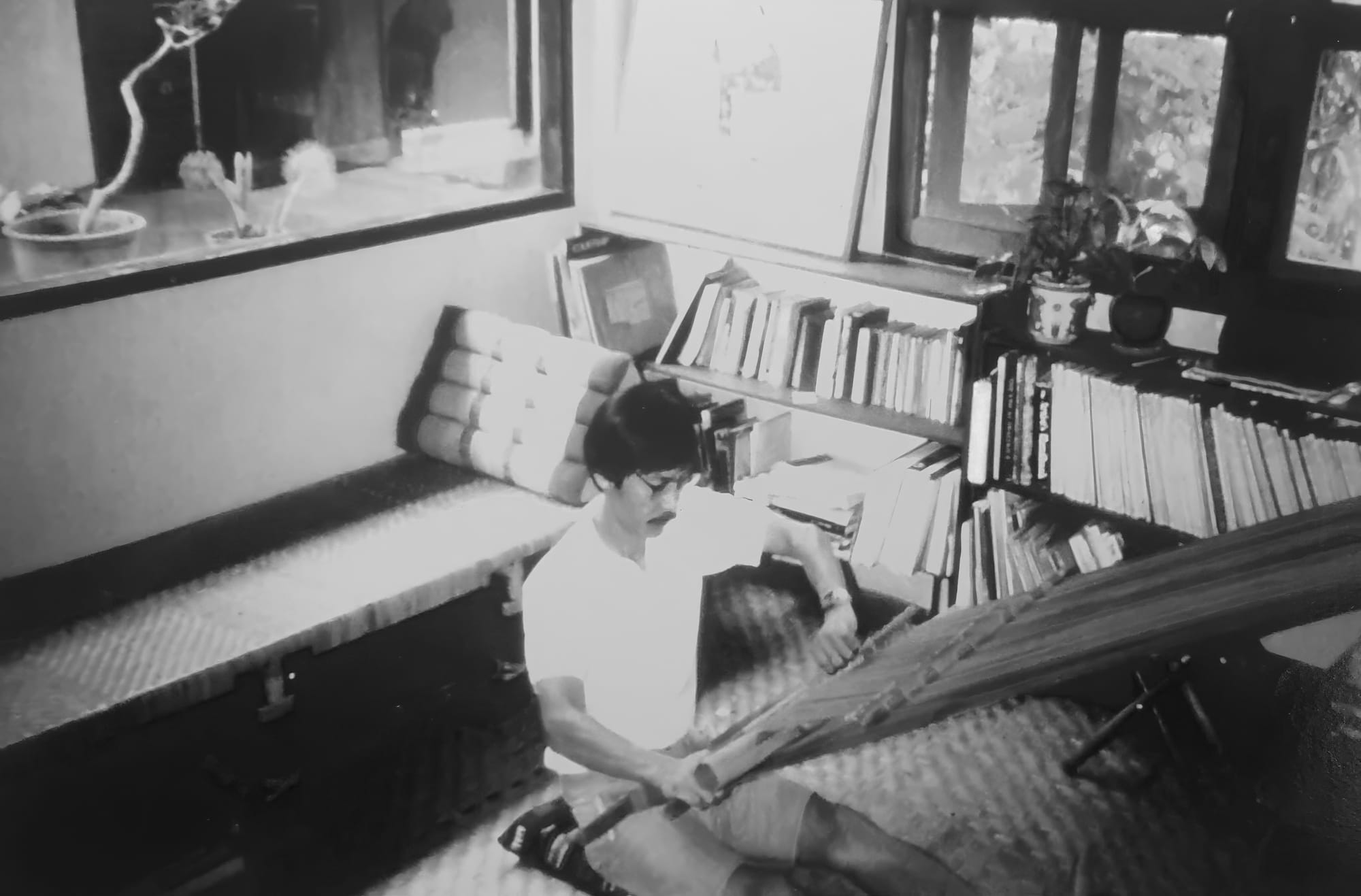
He said: “In 2011, I spent several months living among hill tribe weavers in Northern Thailand, learning their techniques firsthand. This immersion inspired my Grace and Malice series. During this period, I adopted the phaa sin (tube skirt) as a central motif, using female figures to explore layered social and cultural narratives.”
Reconciliation of modernism and religious Beliefs
Wattana’s art often navigates the tension between modern artistic freedom and traditional values. Educated at Silpakorn University and the Rhode Island School of Design, he developed a modern appreciation of the human form. Many of his pieces in the 1960s involved nudes on huge canvases.
This perspective has occasionally conflicted with religious sensitivities. In Terengganu, for example, some Muslim audience members left a presentation due to the presence of partially uncovered women. “But luckily, during the question and answer session, a woman raised her hand and said, ‘I noticed you use a lot of women in your work. Why?’ I thanked her; I was so happy [that] she asked, that she didn’t just walk out. Then I answered her question with another question: ‘Who weaves the textiles?’ They all started nodding. They knew. Men don’t do it. It’s the women.”
“I also merge ancient symbols, such as mandalas, with contemporary digital aesthetics, creating visual bridges between past and present,” he added.
Linking contemporary life with traditional aesthetics
Wattana paints figures adorned with Thai textiles and gold leaf, using the female body to question prevailing notions of beauty and cultural integrity. Quick, expressive brushstrokes convey the turbulence of modern life, while meticulously rendered textile patterns echo the patience of traditional weaving.
This deliberate “tension of opposites” invites contemporary viewers to encounter traditional motifs not as static relics, but as living elements of modern identity.
Evoking contemplation and reflection
The poised, meditative stances of his figures, often only silhouettes, are intended to evoke contemplation rather than sensuality. Wattana encourages viewers to reflect on personal biases and on “what we choose to see and not to see” when confronting conflict or unkindness.
By portraying women who appear “powerless or voiceless” beneath layers of beautiful cloth, he highlights how beauty can be fragile and how virtue may be exploited.
The feminine form as a metaphor for Thailand and marginal Southeast Asian cultures
Through the fusion of craft traditions and the female form, the women in Wattana’s art become metaphors for Thailand’s marginal cultures, indeed for the entirety of Thai culture. They represent traditions that are graceful yet resilient—often overlooked by modern industrial society.
“Like the textiles they produce, these women form a tangible continuity within their communities. They sustain the moral and cultural fabric of society, even as they confront the pressures of greed and cultural neglect,” he said.
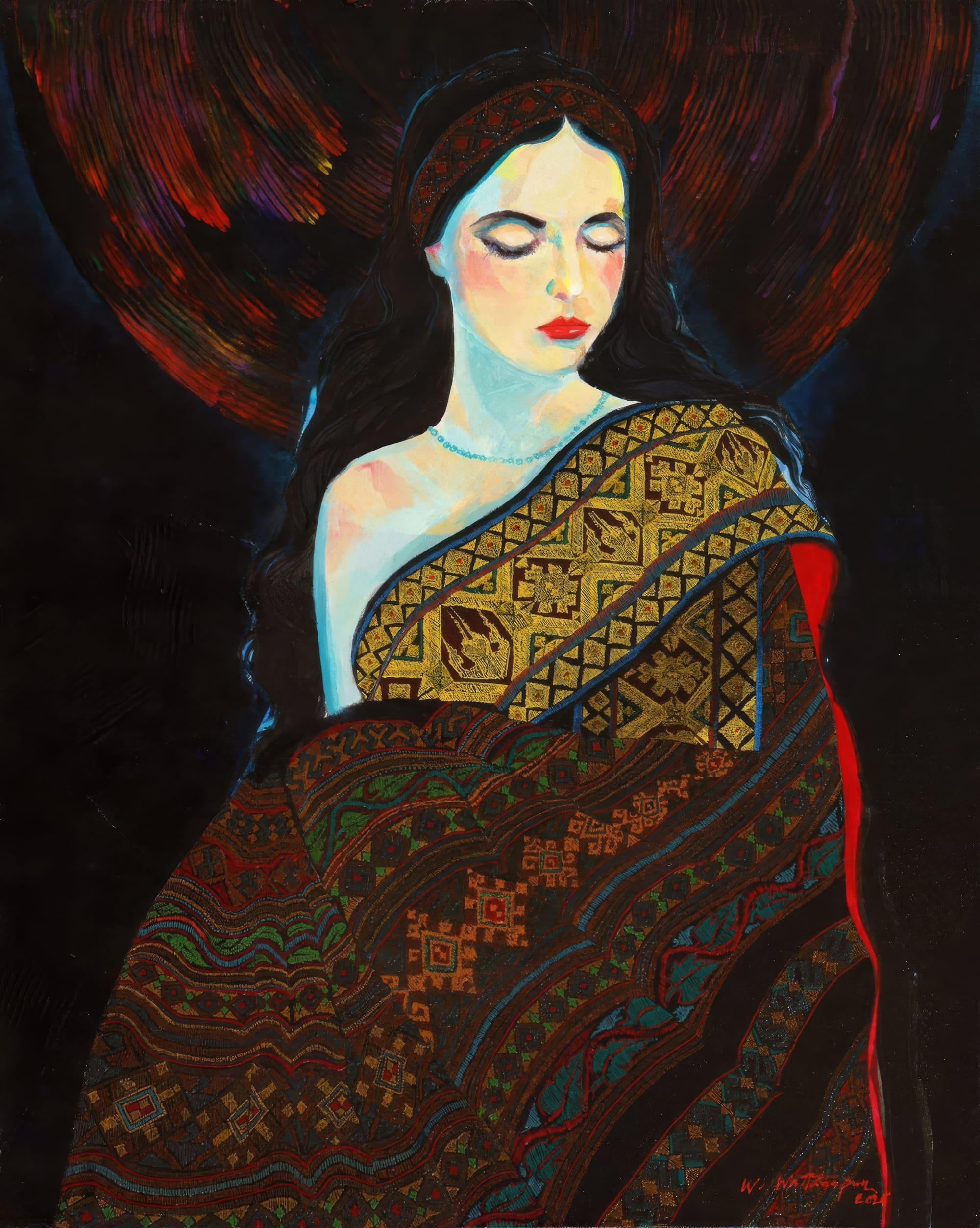
In Sulking, Wattana gently challenges the usual idea of opulence. The richly patterned textile in gold and deep earth tones might at first suggest aristocracy, pride, or aloofness. But the artist shifts our focus to the woman’s expression: her eyes are lowered, her lips gently pressed together, and her face is turned inward. In Thai, this subtle emotion is called ngon. It is a quiet, restrained sulk that often comes from affection or mild frustration rather than anger. It is not dramatic or confrontational; instead, it feels intimate and nuanced. Painting ngon is difficult because it sits between vulnerability and dignity. The glowing skin against the dark background deepens this inward feeling, turning grandeur into something emotionally subtle.
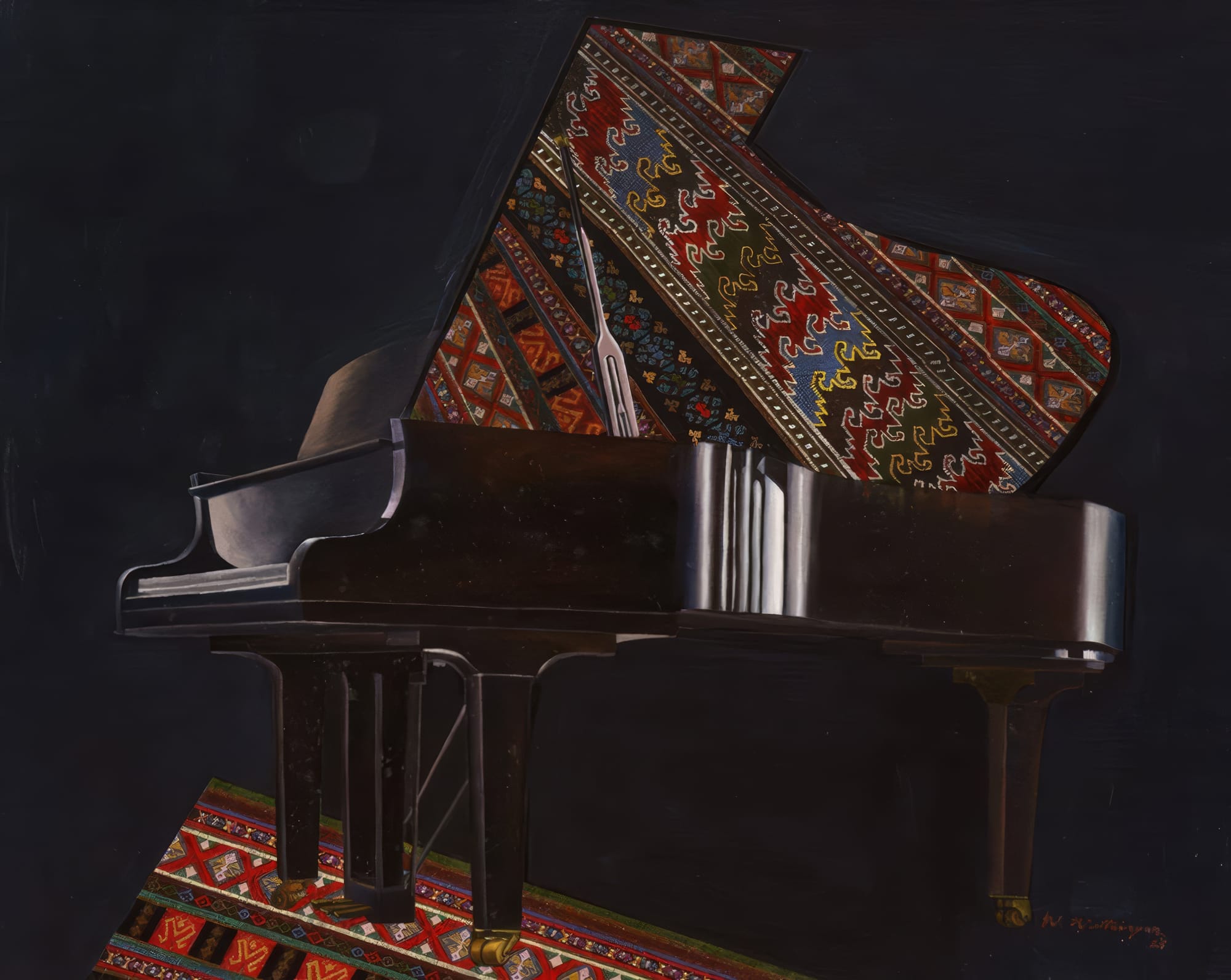
In The Piano Reflection, Wattana brings together his two main passions, music and visual art, in one thoughtful painting. A grand piano—he has one at home—stands out against a hard, dark background, its polished black surface catching and reflecting light. Under it is a richly patterned textile, with detailed designs and warm colours. This textile is more than decoration; its reflection on the piano’s open cover becomes a second image, slightly blurred and softened. The painting shows how different art forms can work together: In Wattana’s case, it merges his two passions into a singular form, showing that we are made of many inextricable facets.
In his own symbolic language, the piano can also be read as an echo of the female form—its curved body, poised legs, and resonant interior recalling the grace and vitality he often associates with women. In this way, the instrument becomes not only a source of music but a quiet tribute to the feminine presence that runs through much of his work.
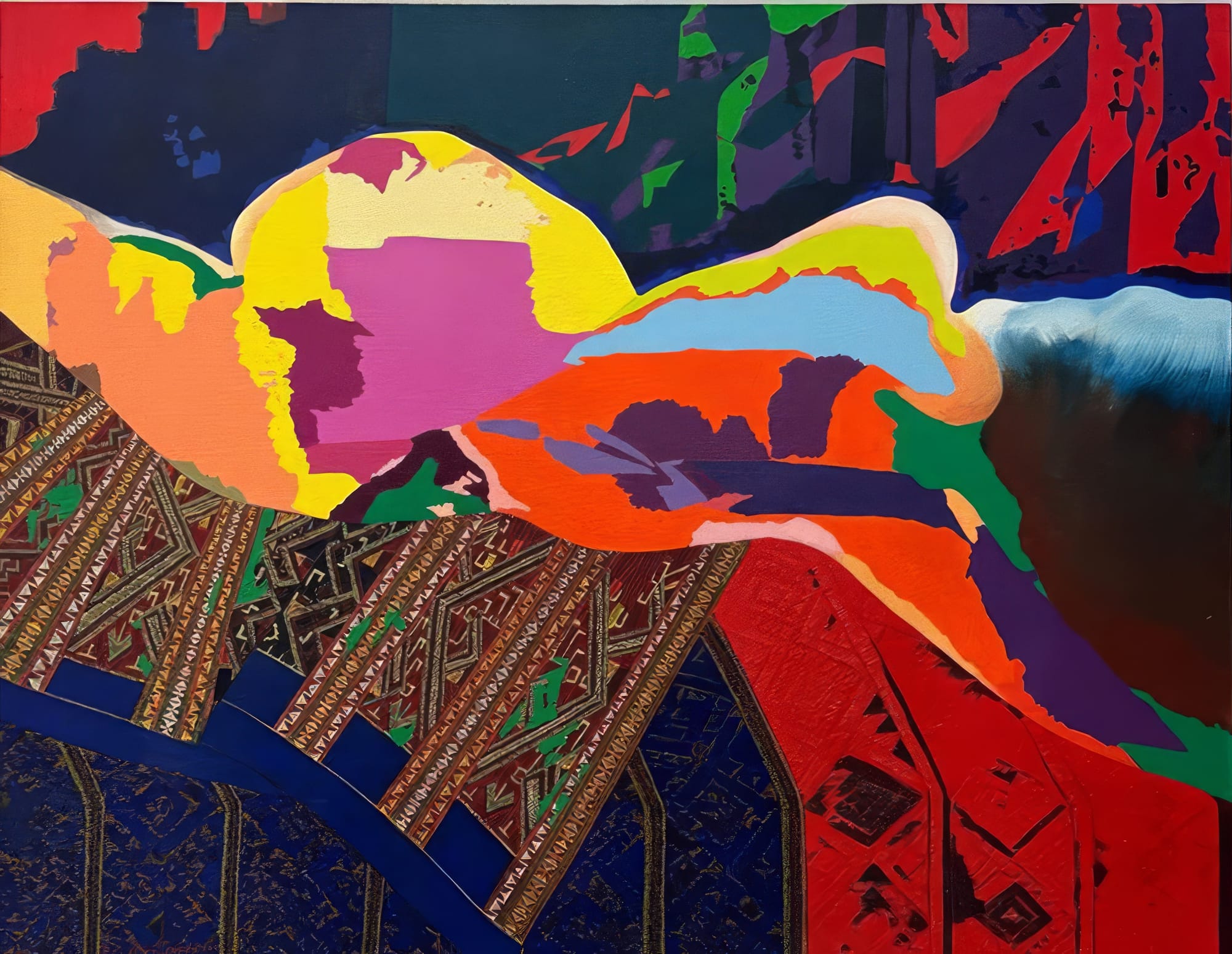
In Double Patterns, he explores a common duality: our discourse, often heated debates, between tradition and modernity. The bottom part of the painting features detailed traditional textile designs that are precise, geometric, and rooted in culture. These patterns feel steady and lasting, representing continuity and memory. Above them, the nude human figure is painted with bold, broken blocks of modern colour. The body becomes a moving, expressive pattern. By combining these two styles, Wattana shows both the tension and harmony between the past and the present. The painting suggests that our identity is layered: it is grounded in tradition but always changing with new ideas.
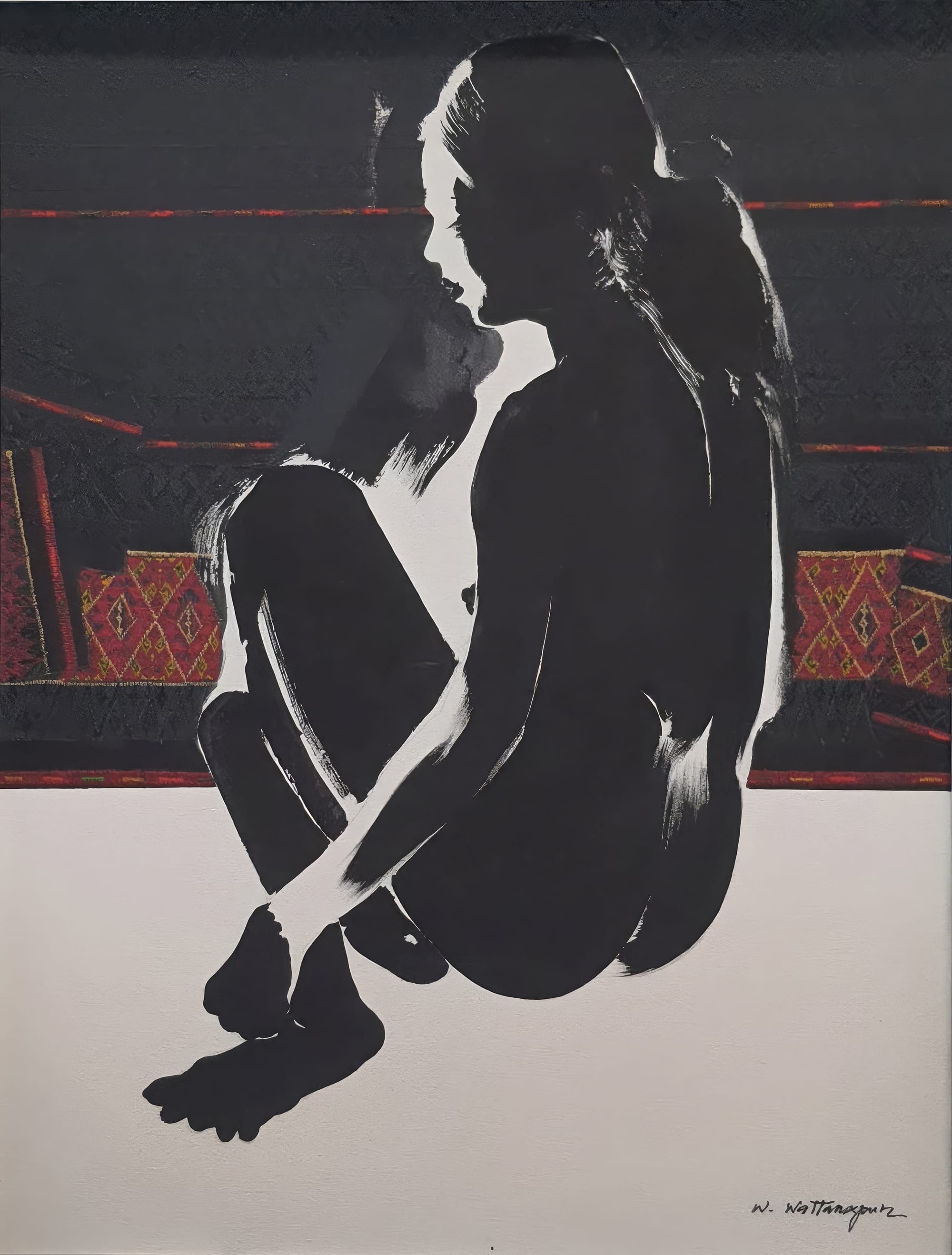
In Two Silhouettes, the artist simplifies the human figure into bold black-and-white brushstrokes. The shapes look like shadows, with two overlapping forms. These silhouettes hint at two stages of life: youth and maturity, innocence and experience. Even though they are different, they blend into a single visual rhythm, suggesting continuity. The textured textile band in the background connects the figures to cultural memory, while the strong contrast between light and dark encourages reflection. With just a few elements, Wattana uses shadow as a metaphor, showing life as a journey in which different ages quietly coexist within one person.
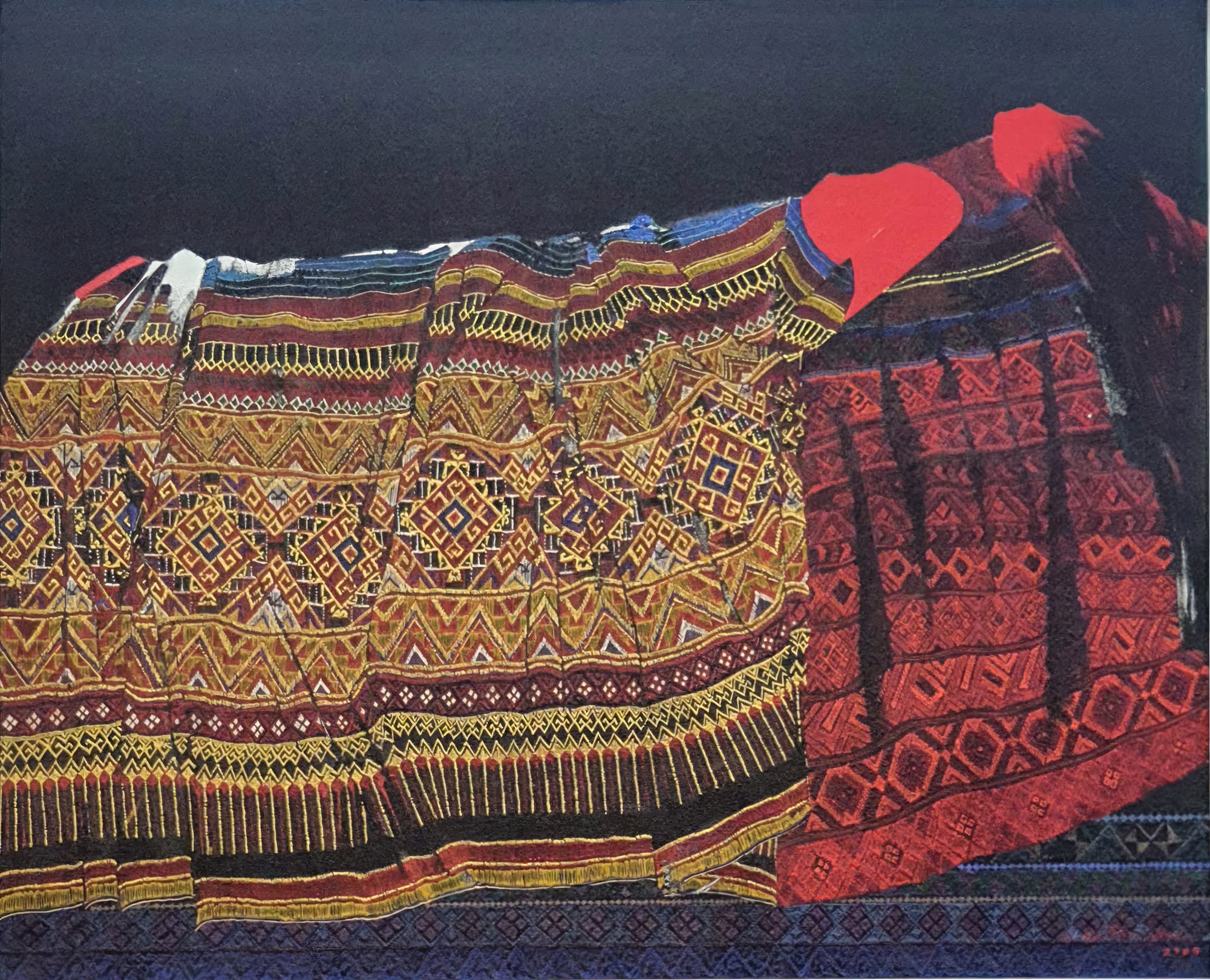
In The Treasure, Wattana is inspired by a traditional belief among village weavers: a master weaver would make her best textile as her last work. It is to be used to wrap her own body for cremation. This final weaving forms part of her legacy, a gift that goes with her spirit to heaven.
In the painting, a woman is wrapped in detailed patterns that glow with gold, red, and deep earth tones. Only faint traces of her body and face can be seen. The viewer is left to wonder: is she sleeping, unwell, dying, or already gone? This uncertainty adds to the emotional tension of the piece.
The textile is the painting’s main focus, acting as both a shroud and the central character. Wattana takes the idea further, making it about culture as well as the individual. The “treasure” is not just the beautiful textile, but also the tradition behind it. As fewer artisans keep these practices alive, the painting gently asks if this heritage is also fading away. Is the textile sustaining life, or marking its end?
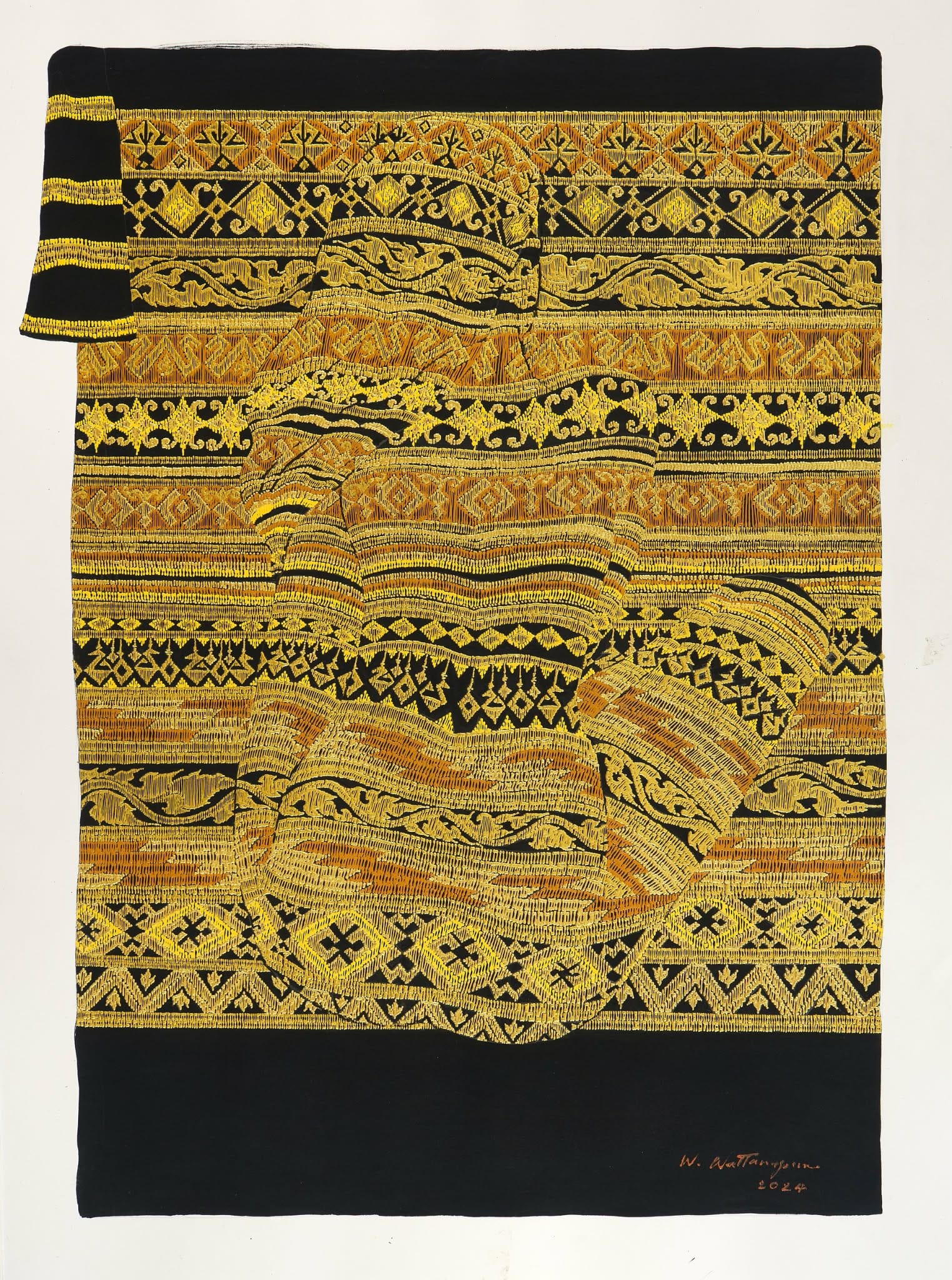
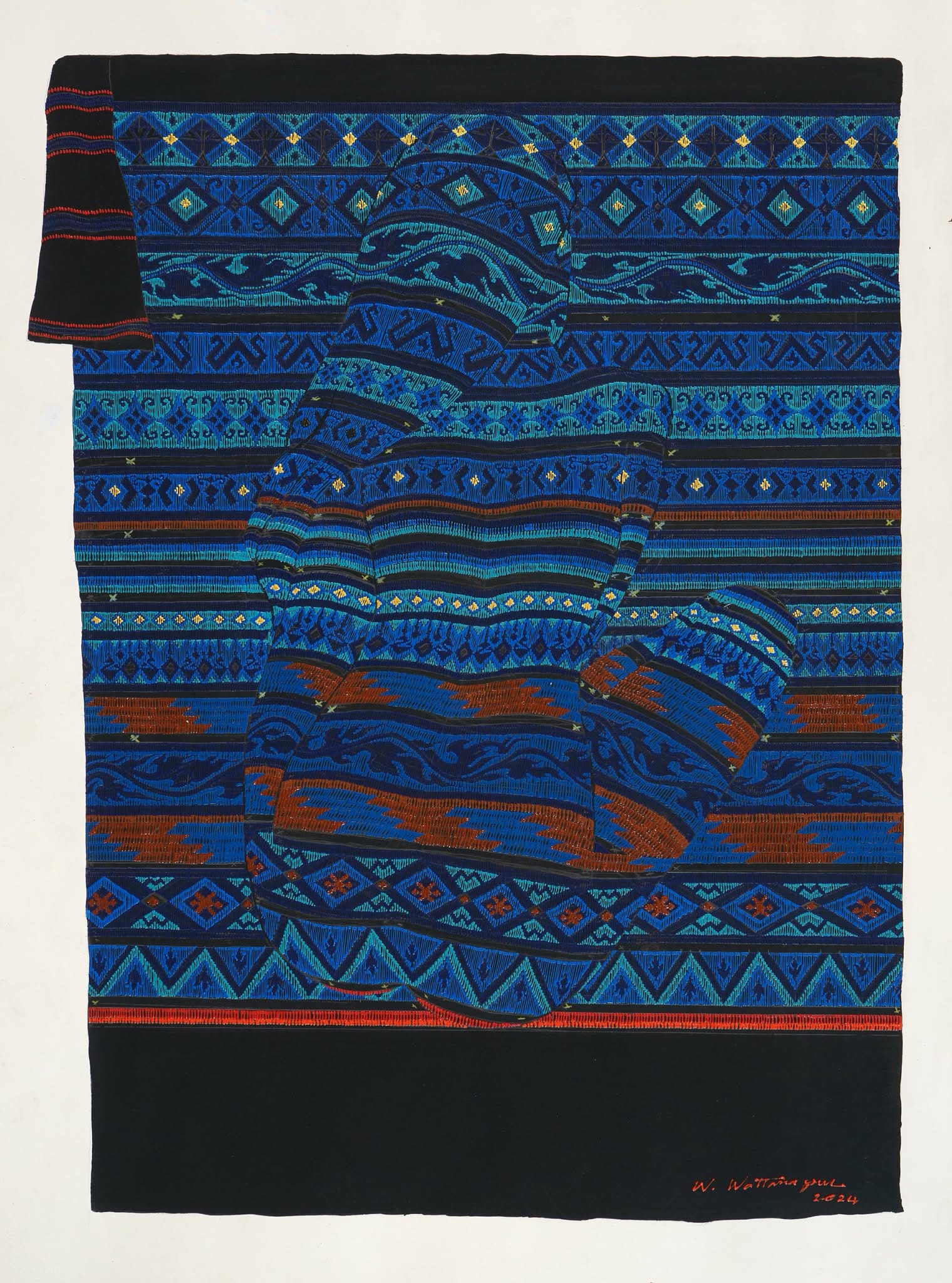
Hem Series: Gold and Indigo Blue – Woven Weaver, acrylic on paper, 76cm x 58cm 2000-2025
In the Hem Series of five pieces, the artist looks back at the weaving traditions of Mae Chaem, Chiang Mai. In one piece, the deep indigo colours remind us of natural dyes that have long been part of village craft, rooting the work in its place and heritage. A Thai saying, “Those who wear, don’t weave. And those who weave, don’t wear,” points out a quiet social irony: artisans create beauty and value, but rarely enjoy the status their work brings.
Within the patterned tube skirt, a nude female figure is woven into the fabric itself. She is not just shown on the cloth, but becomes part of its very structure, as if the weaver has placed her own body and identity into the fabric. The line between maker and object disappears. With this, Wattana honours the hidden work of women artisans and questions why creation and recognition are often kept apart.
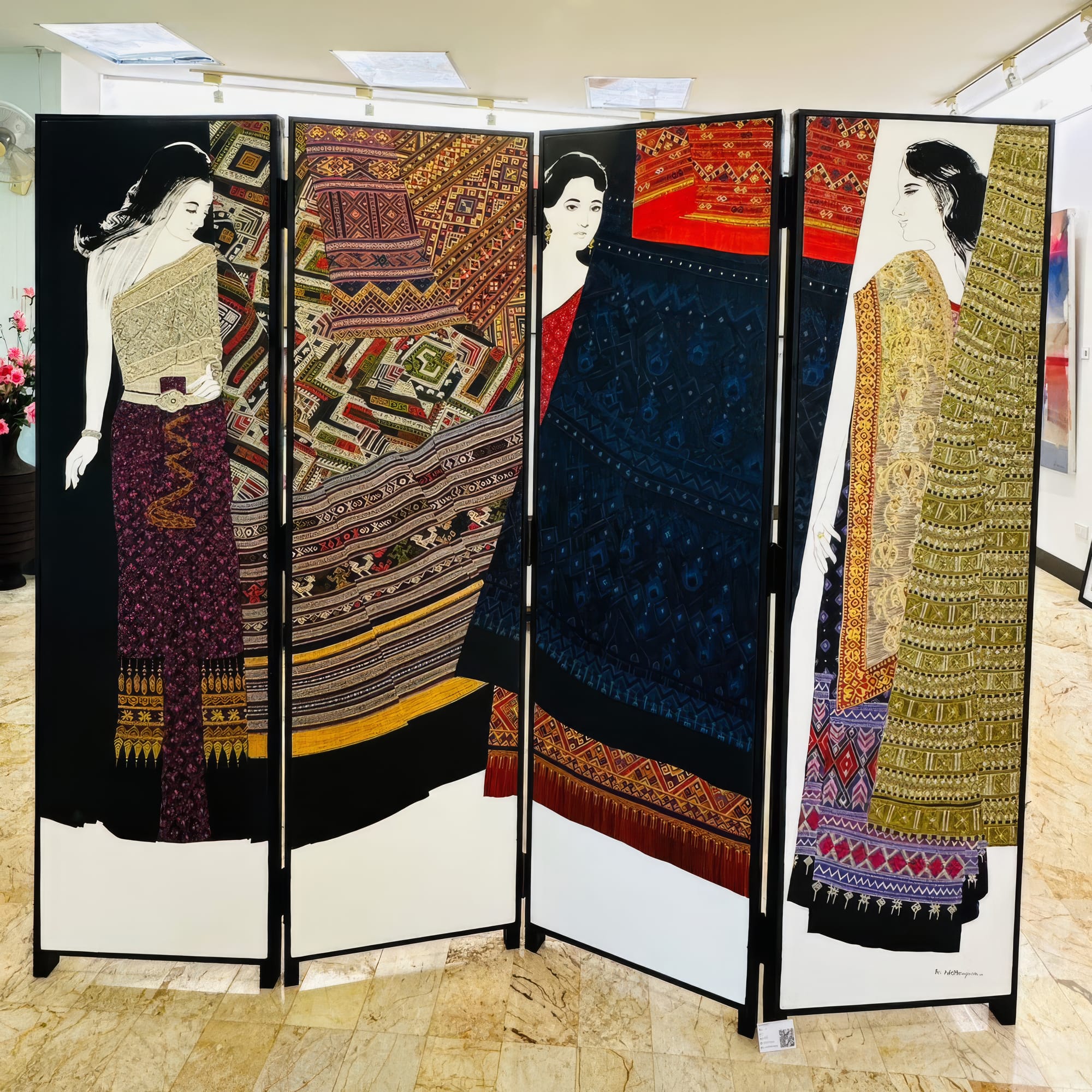
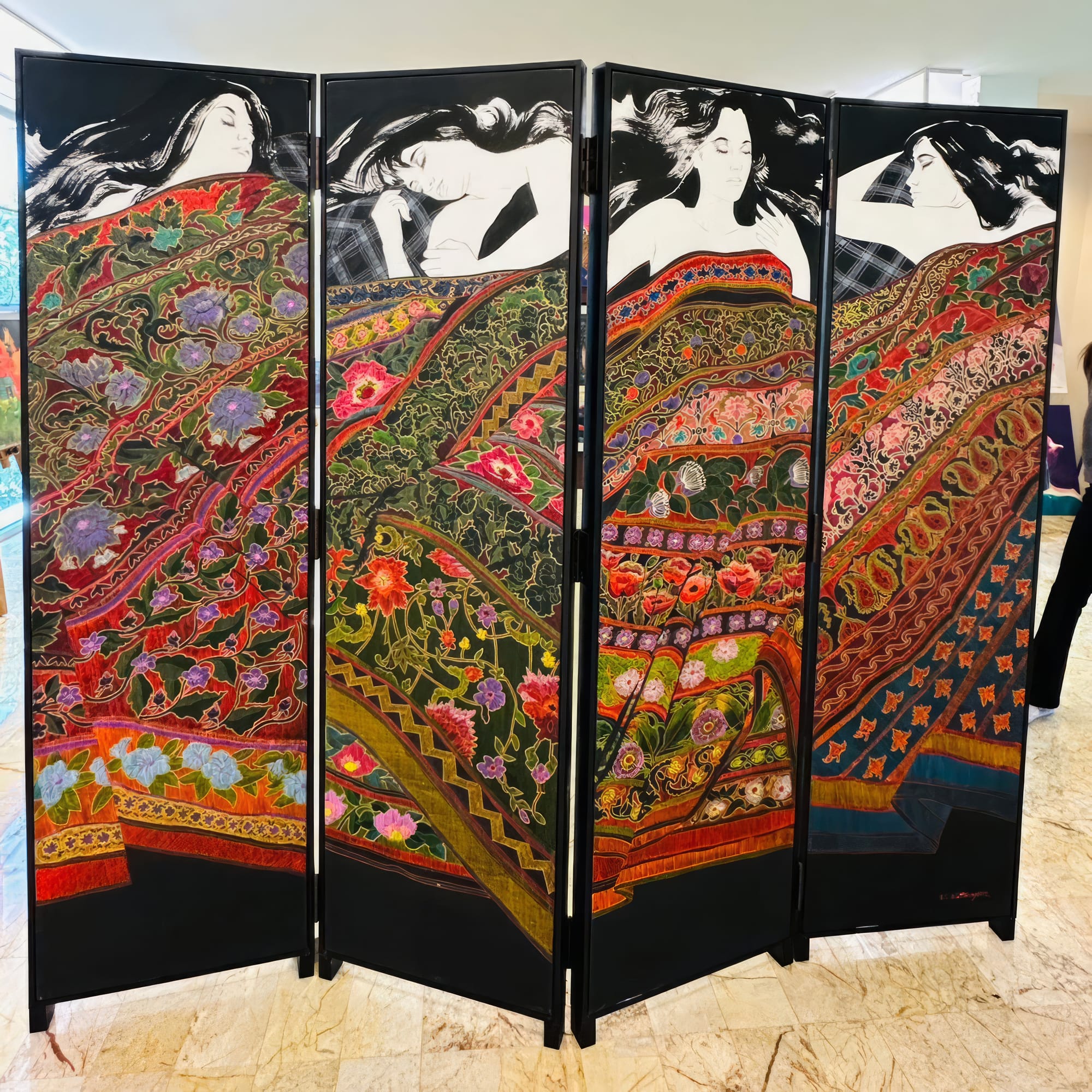
Night & Day partition, acrylic on canvas, 185cm x 220cm, 2015
In Night & Day, Wattana Wattanapun turns the traditional folding screen into a reflection on duality, a common theme in Eastern philosophy. The screen usually divides public and private spaces, but here it also separates different states of mind and time. One side shows daylight, with figures standing upright, alert, and dressed in bright textiles with glowing patterns. The other side suggests night, with reclining figures, softer expressions, darker colours, and fabrics that hint at rest and reflection.
The four panels open like chapters, moving between wakefulness and sleep, between inside and outside, between East and West. Textile patterns weave these different states into a single cultural story. The women seem both unique and universal, showing cycles of time and identity. With this setup, Wattana invites us to consider how we shift roles in different situations and how light and shadow, action and rest, coexist in our lives.
WATTANA IN THE DIGITAL SPACE
Wattana Wattanapun biography (Source: askart.com) Click here to read
Summary: This biographical profile highlights the distinguished career of Wattana Wattanapun, a Thai artist and educator who has worked extensively across Thailand, the United States, and Canada. Educated at Silpakorn University and the Rhode Island School of Design, he is celebrated for seamlessly integrating traditional Thai motifs with contemporary artistic perspectives. Utilising diverse media such as oil, acrylic, and gold leaf, Wattanapun is particularly renowned for his depictions of textiles and abstract nature scenes. The article notes his significant academic contributions, including visiting professorships at prestigious institutions, and his ongoing role as a consultant in Chiang Mai’s vibrant arts community.
Painting a Legacy: The Art and Times of Wattana Wattanapun (Source: Citylife, Chiangmai, January 28, 2013). Click here to read
Summary: This interview chronicles Wattanapun’s return to Chiang Mai to establish a permanent gallery for his extensive collection. He discusses his “Grace and Malice” series, which uses hyperrealistic painting techniques to replicate the textures of ethnic hill-tribe textiles. The artist explains that these works serve as a poignant metaphor for the social and cultural struggles faced by marginalised communities in Southeast Asia. By portraying women—the “voiceless weavers”—wrapped in intricate fabrics, he highlights the exploitation inherent in the tourism industry. The article captures his dedication to preserving cultural heritage and his belief that art should function as a medium for social commentary.
Artist’s statement: Grace and Malice (Source: wattana-art.com). Click here to read
Summary: Wattanapun’s official artist statement provides a deep conceptual exploration of his Grace and Malice series. He frames traditional textiles as a “social text” that both identifies the unique heritage of mountain people and signifies their displacement by modern society. The “grace” of their craftsmanship contrasts with the “malice” of societal greed and cultural blindness that threatens their existence. The artist challenges viewers to examine their own biases and the “selective blindness” often adopted during times of conflict. By depicting figures in vulnerable or desperate situations, he urges an honest reflection on the human consequences of power, policy, and cultural dislocation.
Man of Conscience (Source: Bangkok Post, December 12, 2012). Click here to read
Summary: This profile details the opening of the Wattana Art Gallery in Chiangmai, a project funded by the artist’s personal savings to serve the local community. Wattanapun envisions the space as a spiritual and creative sanctuary, similar to a Buddhist temple. The article highlights his concern about the rapid urbanisation of Chiang Mai and the subsequent loss of traditional beauty and “marginal culture.” Through his gallery, he aims to promote art education and raise awareness of art’s social functions. By showcasing works that blend mixed media with social critique, Wattanapun reaffirms his commitment to sustaining society’s moral and cultural fabric.
Note of thanks: This story was put together with the invaluable research assistance of Kenneth Ang, who worked with me in Kuala Lumpur in the 1990s. He lives in Chiang Mai.