One Horizon, many perspectives
A HORIZON is where the sea appears to meet the sky, a line that separates two worlds while bringing them together in a single view. In One Horizon, Penang photographer KF Choy draws on this idea to explore the people, places and memories that connect us, even as time and circumstances set us apart.
Through his photographs, Choy brings different moments in Penang’s history into focus, from everyday scenes of working life to a tragedy that has faded from public memory, and the vessels that have carried generations across the Penang Strait. Each offers a different perspective, yet all hold a common thread of “Humanity for Humanity”.
Light and shade play an important part in how these stories are told, dancing across the textures of his prints. By transforming familiar scenes into something less immediately recognisable, Choy asks viewers to look beyond appearances and question what they see. This approach runs through all three chapters of his exhibition.
In a philosophy alongside Buddhism and other Eastern traditions, Choy draws on ideas of care and impermanence, and on the Japanese aesthetic of wabi-sabi, which finds beauty in what is imperfect and passing. “Everything is impermanence. But can we accept impermanence? Can we accept imperfection?” he asked, observing that when faced with imperfection, we feel we have to “perfect the imperfection”.
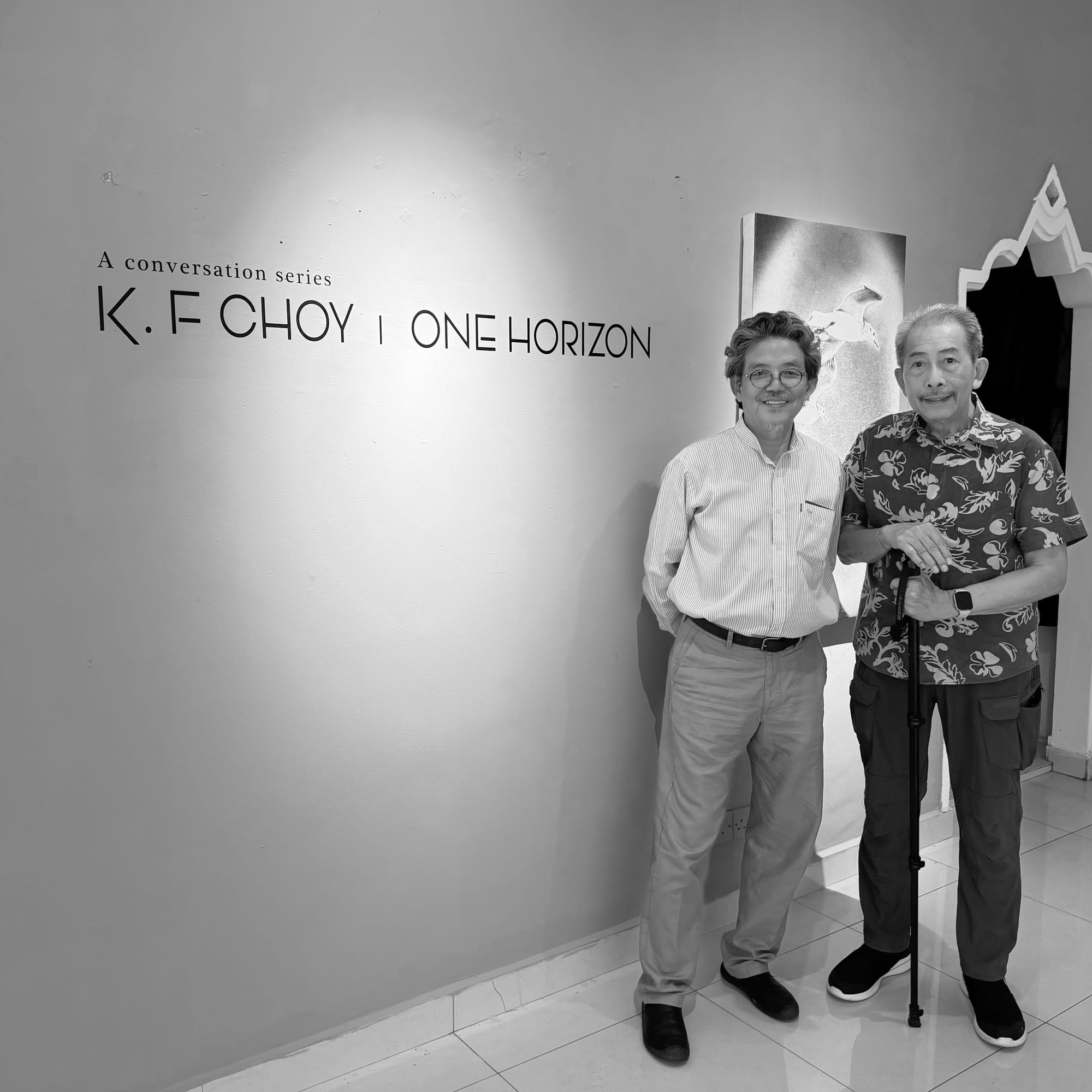
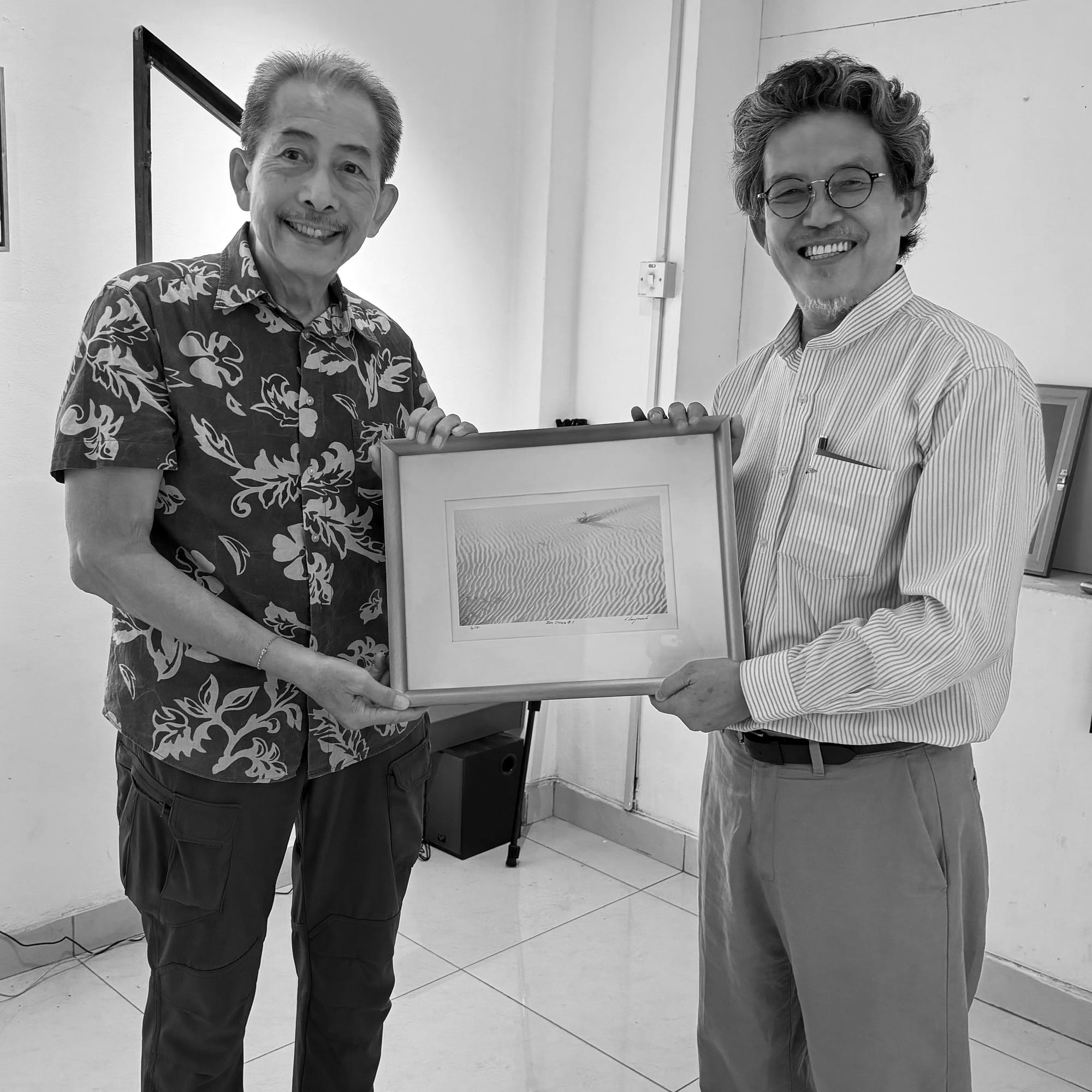
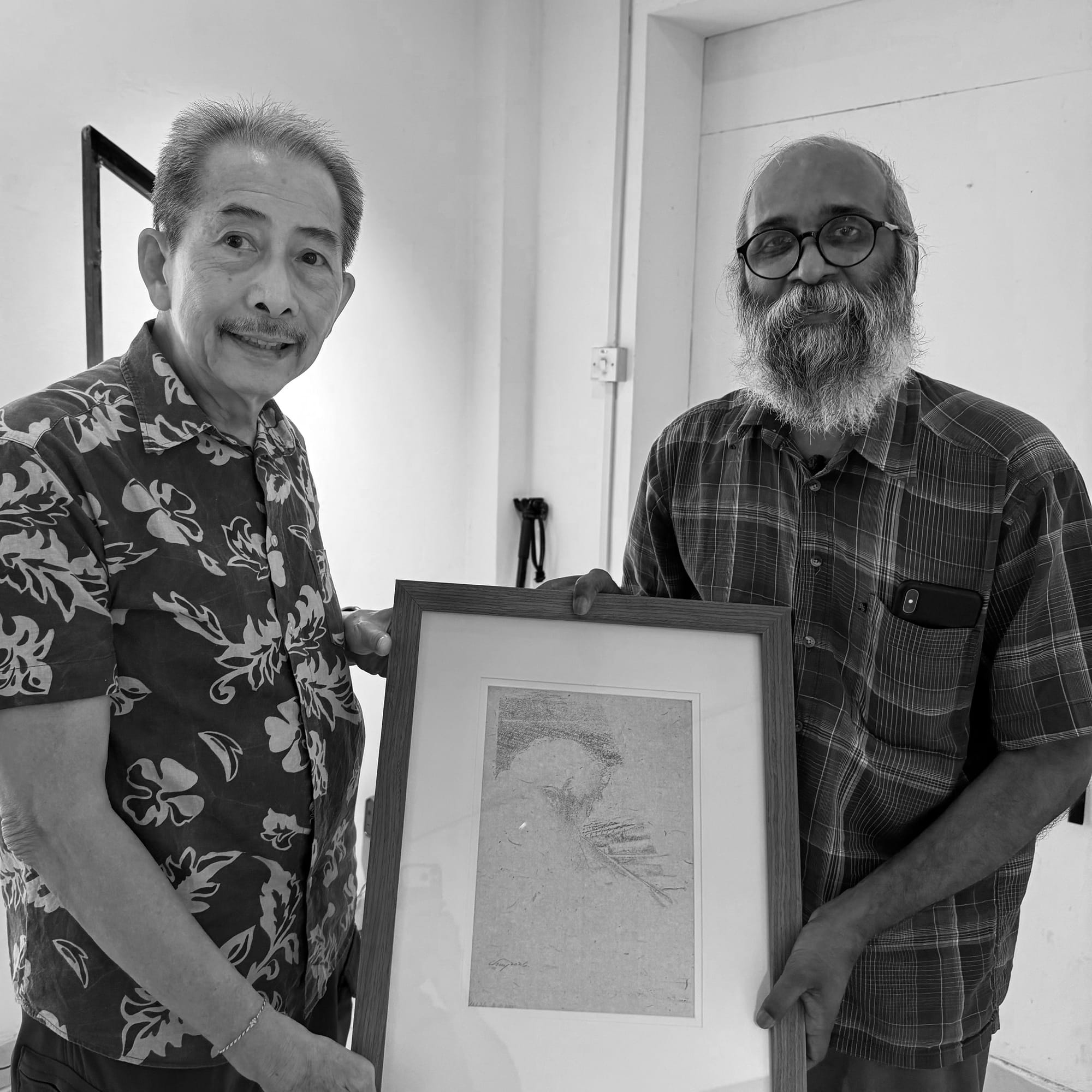
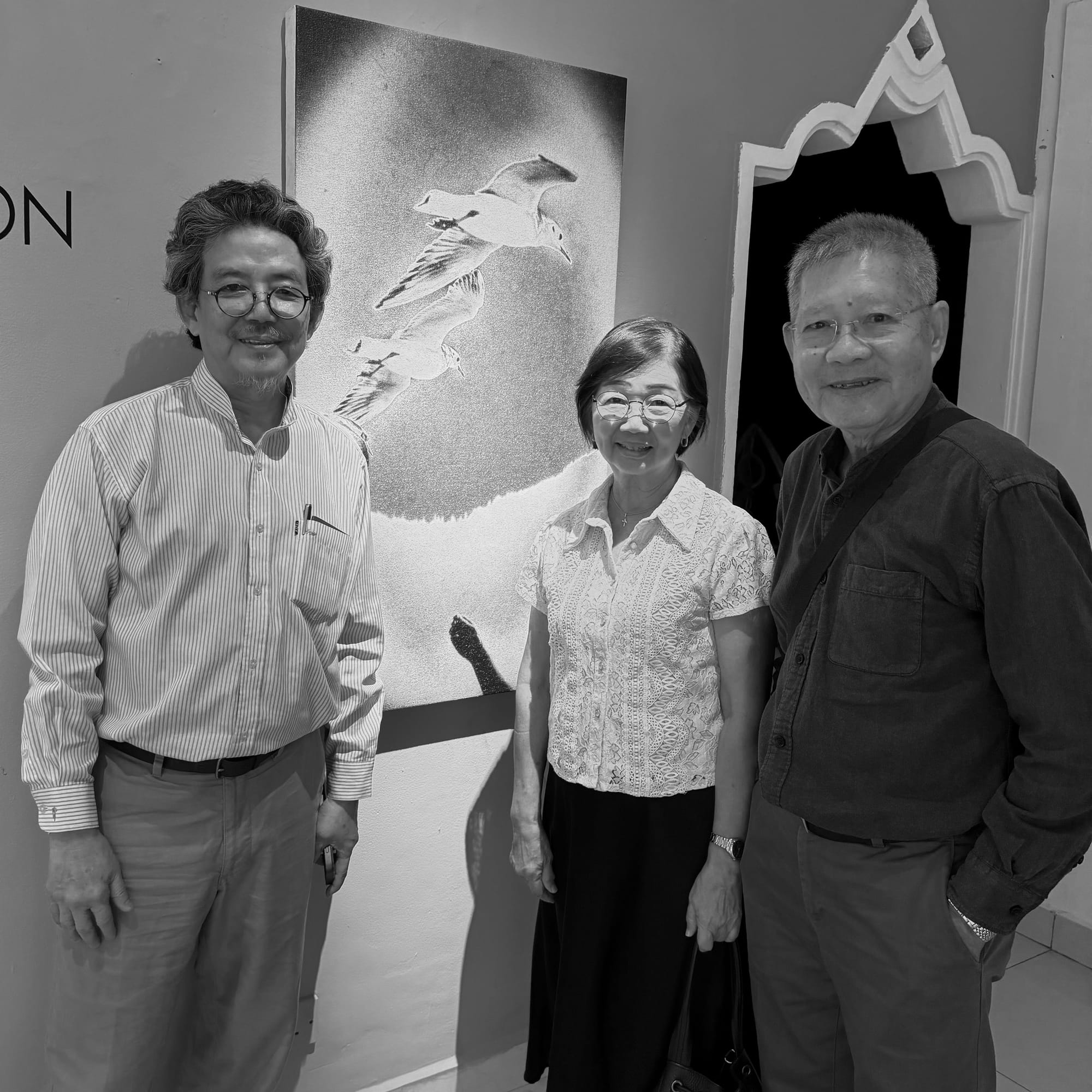
Held at ArtVoice Gallery in Sentul, Kuala Lumpur, and presented as “A Conversation Series”, the exhibition was opened on October 24 by Penang Institute executive director Dato’ Dr Ooi Kee Beng. Choy’s invitation to visitors came down to a single proposal: “Penang, let’s have a conversation”.
“I want to quiz people. I want to engage people. I want them to question it. Otherwise, it becomes a one-directional speech. I want a conversation,” he said in an earlier interview, when he exhibited alongside six other artists in For Our State at Penang Institute in September.
Arrow of Humanity, held at the edge
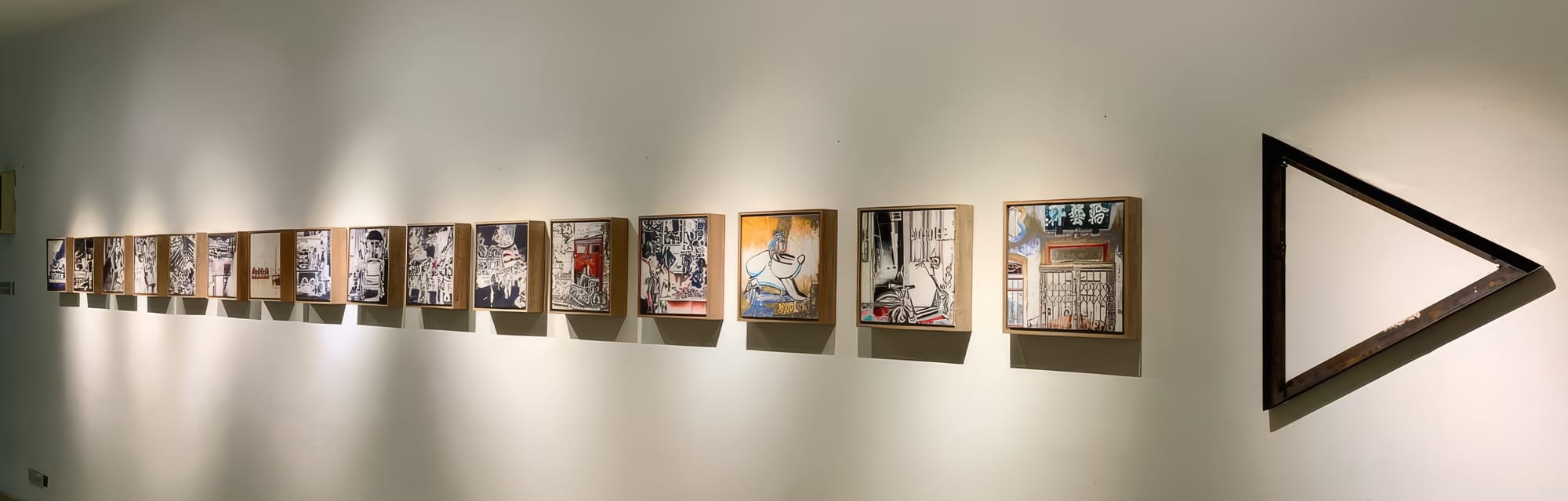
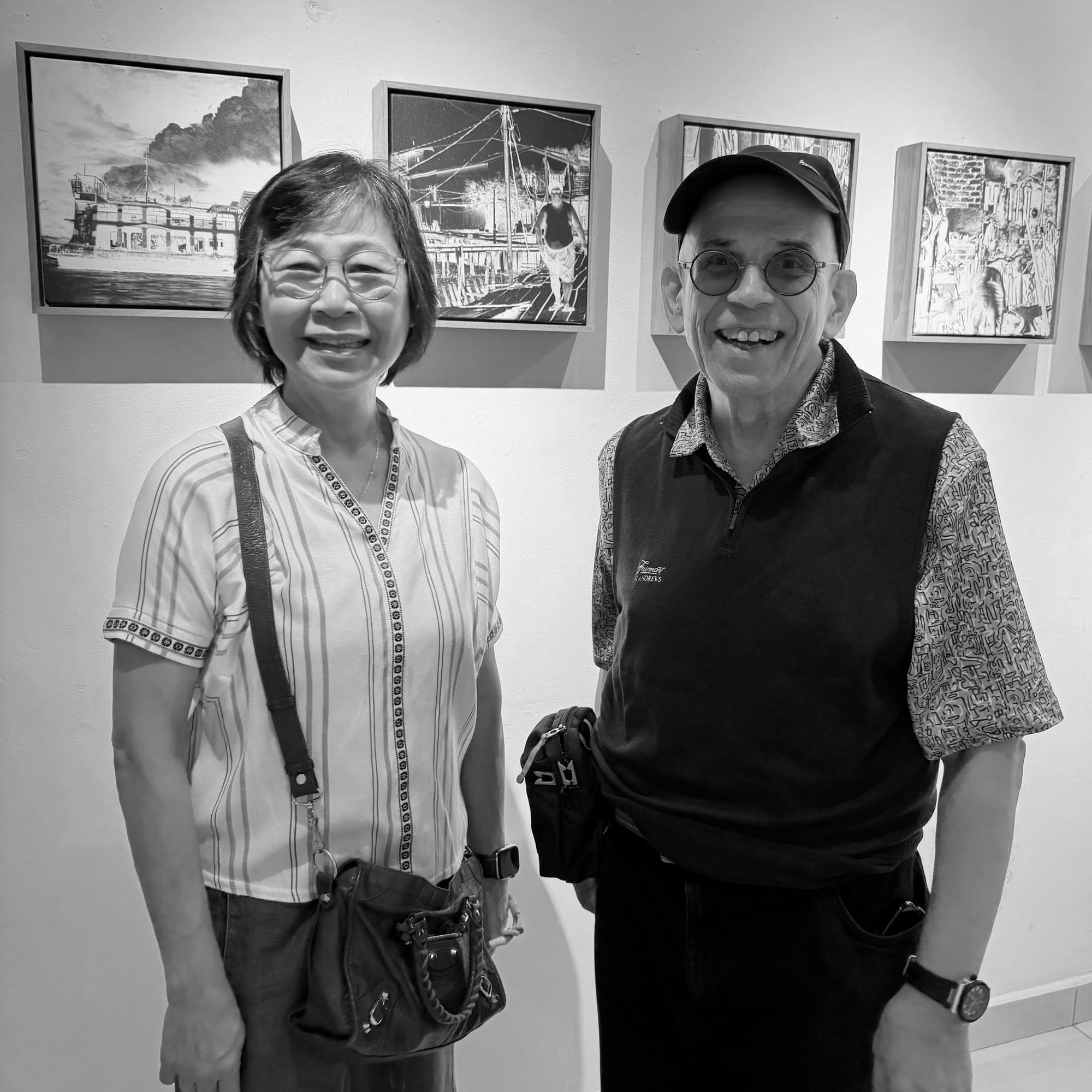
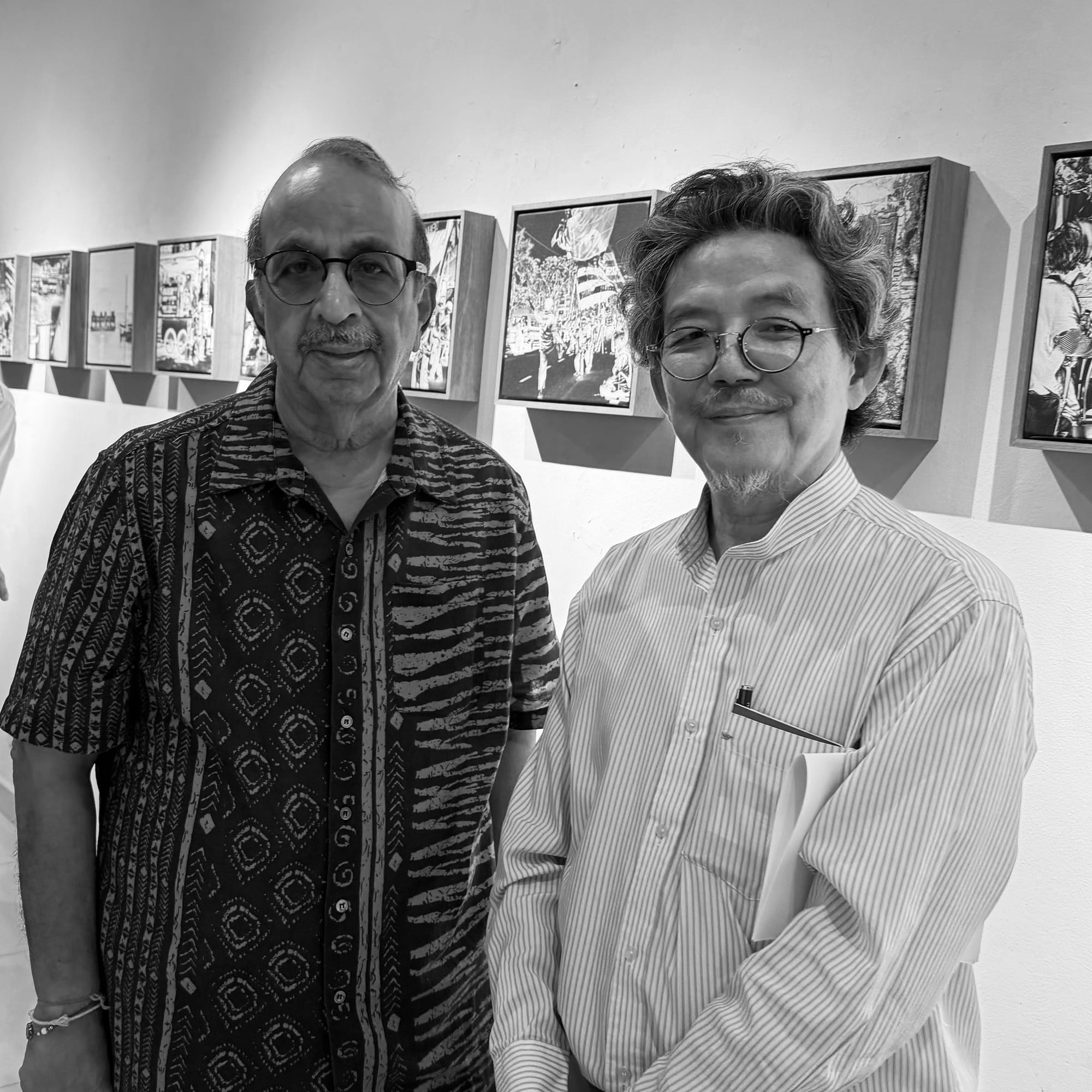
The One Horizon exhibition begins with Arrow of Humanity. Here, sixteen 12″ x 12″ square works, pigment inkjet prints on linen canvas set in wooden box frames, hang in a single line along the gallery wall on the ground floor. The row forms a horizon of its own, ending at a triangular arrow that neatly ties the works together as a progressive statement, “all moving as one”.
The arrow is fashioned from raw angle iron instead of finished metal, which Choy said was deliberate to emphasise the state humans are born in, without embellishments. In his view, we come into the world with nothing and leave with nothing.
The subjects belong to everyday, working Penang, from a Peranakan shophouse with its carved wooden signage and a pintu pagar that Choy calls “a disappearing architectural feature of Penang’s domestic heritage”, to a figure crossing a wooden bridge towards a waterfront home, a Chingay performer balancing a towering bamboo flagpole, a fisherman mending his nets and a pushcart frying mee goreng mamak.
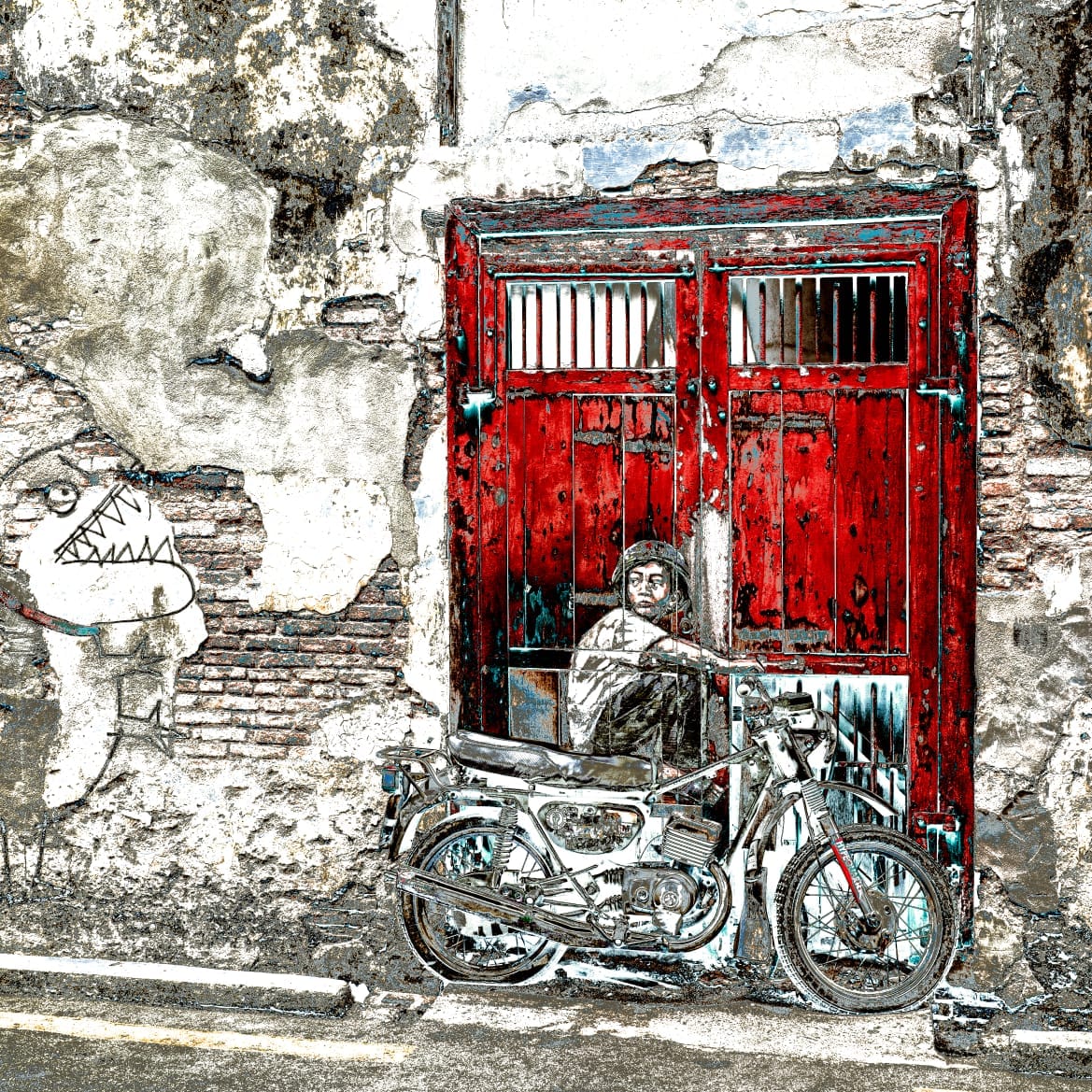
Elsewhere, a trishaw rider chats with European visitors, workers linger after the market closes, and Ernest Zacharevic’s Boy on Motorbike reappears in a new guise, so that the whole row reads as a nostalgic horizon, a Penang slowing down as it nears the edge of memory.
What makes these scenes memorable is the way Choy prints them. Using solarisation, the digital descendant of the darkroom’s Sabattier effect, he reverses light and dark so the prints sometimes read almost as negatives. At the same time, what we normally overlook is highlighted with colour. As a result, the mind keeps trying to flip each image back to what it ought to be. The act of looking becomes meditative, training the mind to observe rather than react, which suits a man who once described himself as “a very slow shooter”.
This device is clever and prompts viewers to consider why the people are stripped of colour. Perhaps this is where Choy’s “one humanity” comes through most, as something you can actually see on the wall.
“No one is greater than the other. There’s no such thing as, ‘Oh, you’re smaller than the other person.’ No, we are all equal,” he said.
1988 and the 12 missives
From the everyday lives of Penangites, Choy turns in the second chapter, 1988, to a tragedy that brought many such lives together on one fateful afternoon.
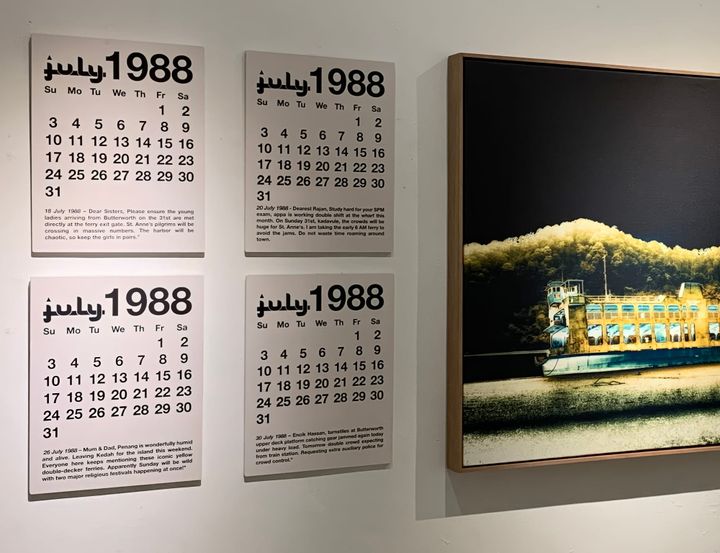
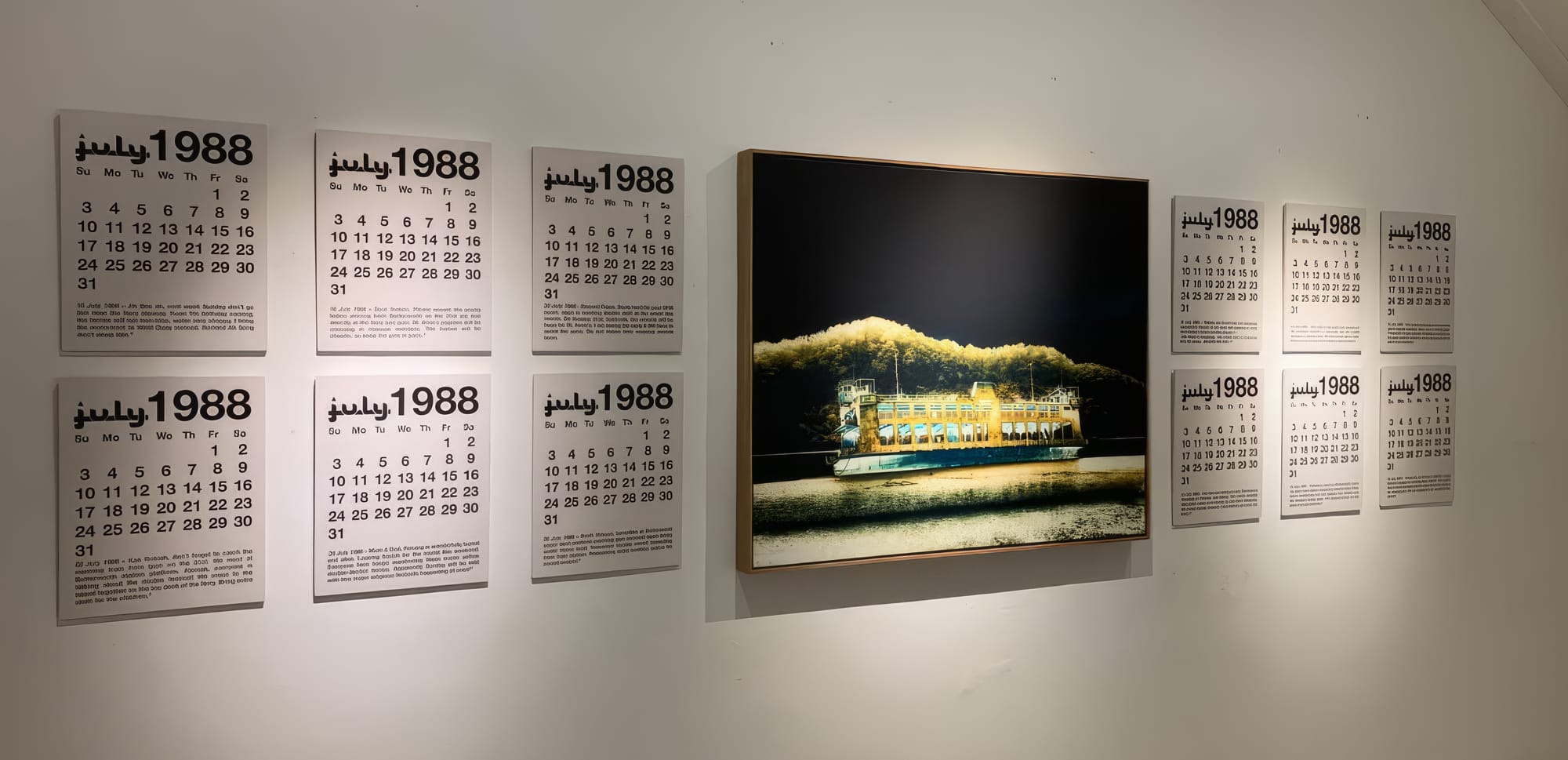
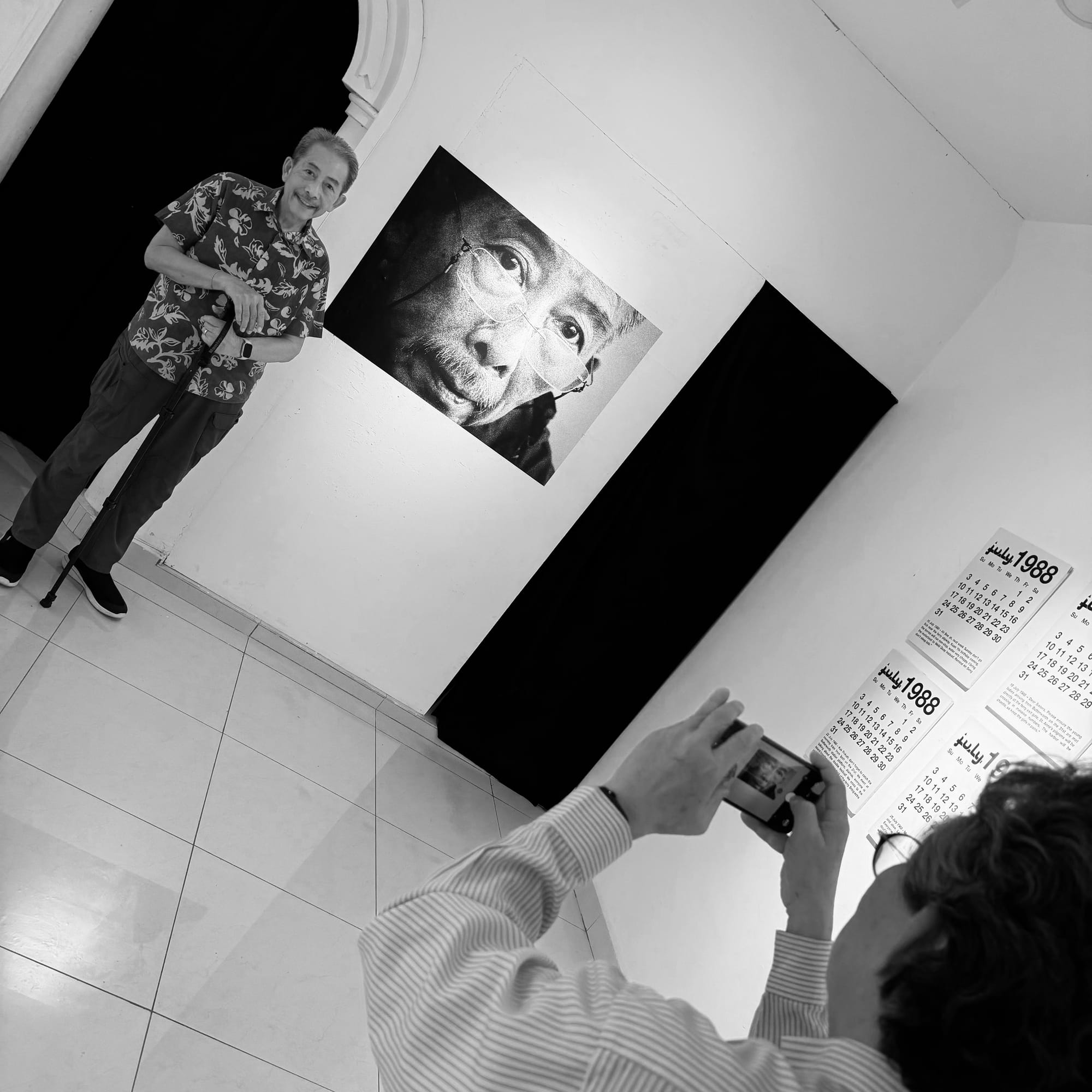
Here, he makes a bold statement in documenting the tragedy of July 31, 1988. His 54″ x 60″ print is the focal piece, accompanied by 12 missives, six on each side. Each calendar page tells a different story, building toward the tragedy in a stringendo manner, as in music, to indicate rising tension. The ferry glows gold and turquoise against a black sky, using what Choy calls “non-representational colours”.
“I do not want to depict it or illustrate it as a disaster,” he said. “When we are faced with a disaster or negativity, the most important thing to ask is, do we have compassion?”
Choy wrote the missives himself, constructing 12 different people from different strata, six going about their lives in the days leading up to that Sunday and six caught in the crowd on the day itself. In this second chapter, time is literally suspended in July 1988, forcing viewers to look with a microscopic eye at what happened in a split second.
In his artist statement, he writes, “Rather than reconstructing the tragedy, the work delivers a subtle reflection on loss, collective memory and compassion for those whose lives were changed.”
Just one horizon
If the first chapter looks at the lives of ordinary Penangites and the second at a moment of communal tragedy, the third brings different generations and journeys together within a single frame.
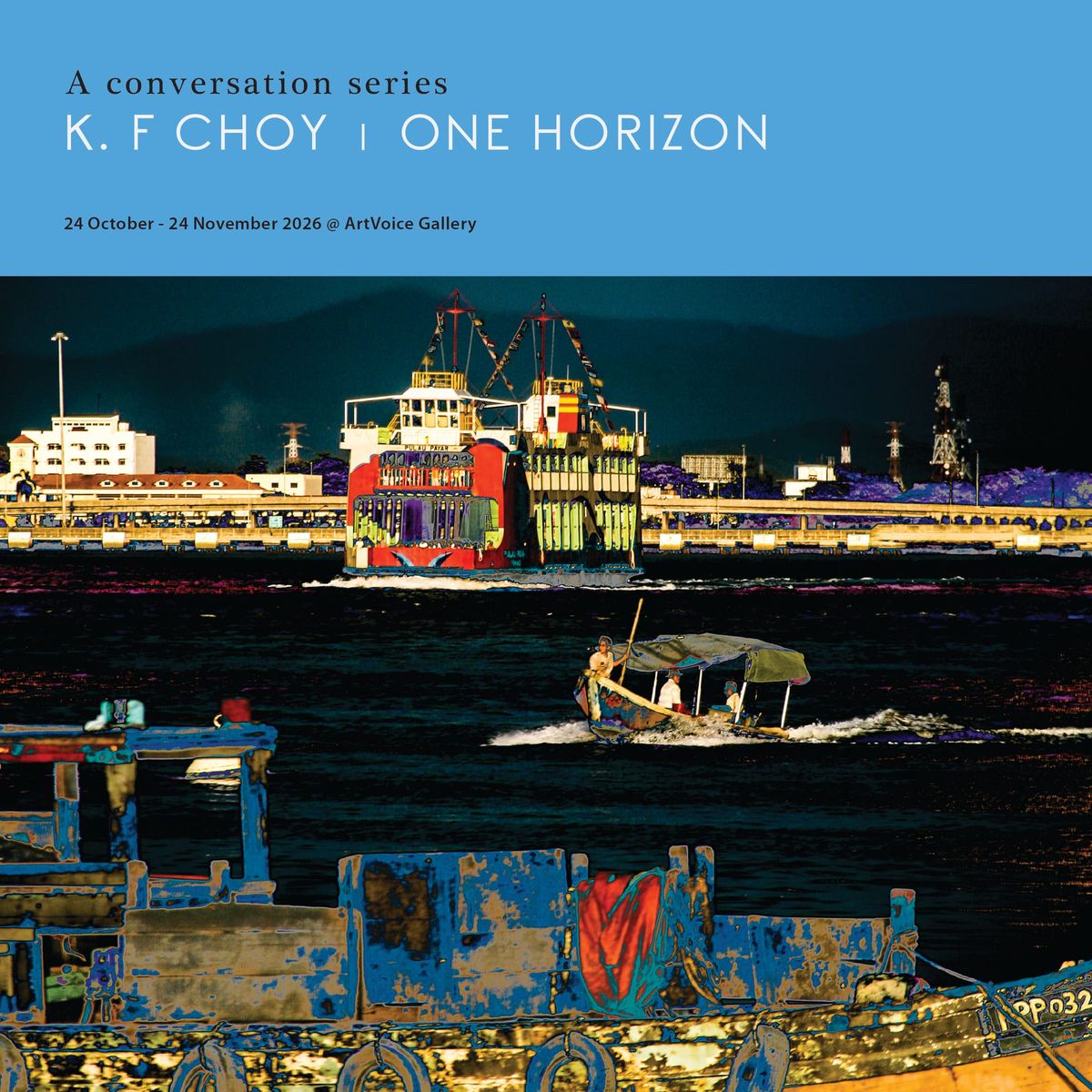
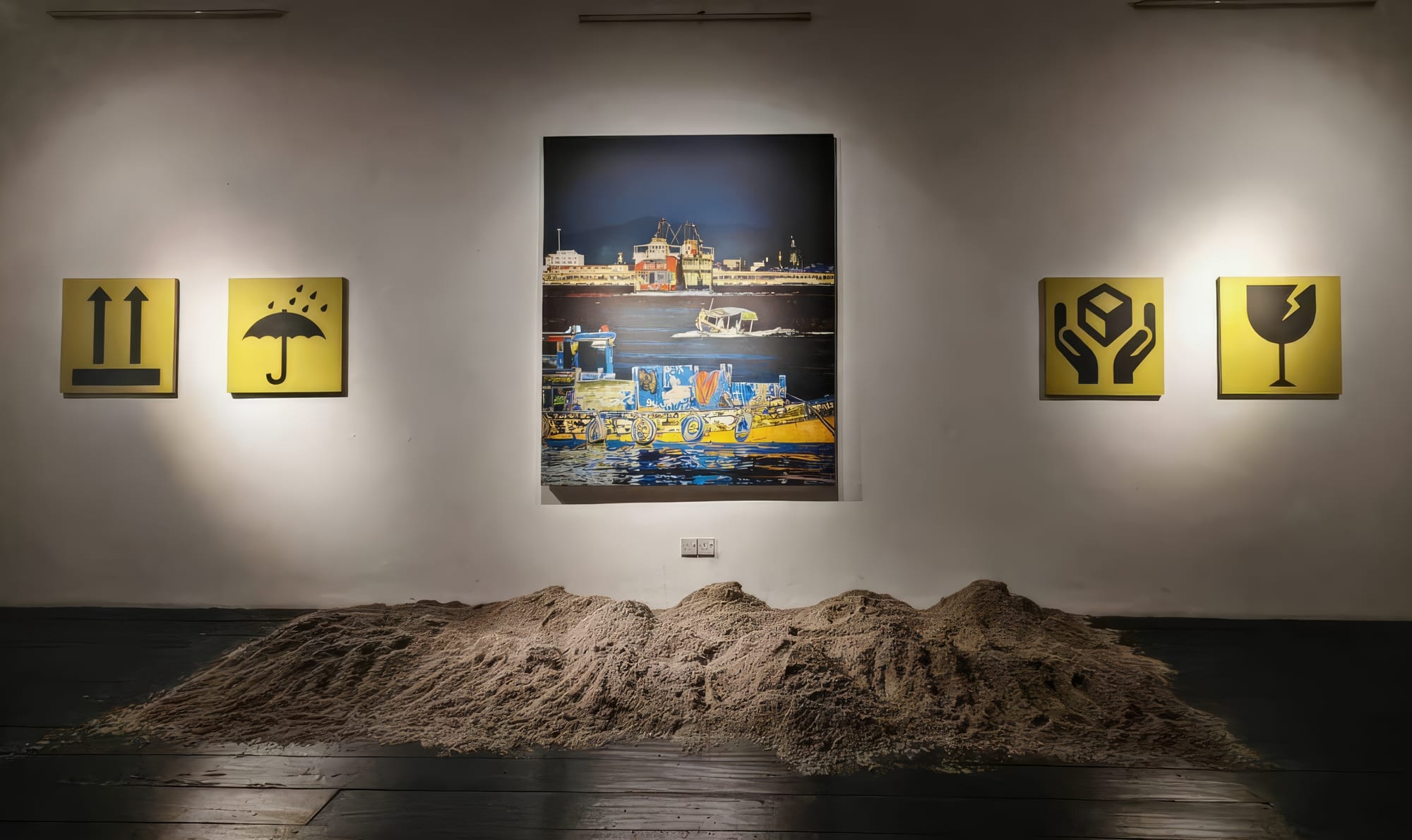
In One Horizon, Choy brings together in a single exposure an old boat he calls a tongkang, a wooden speedboat and a Penang ferry, three vessels from three eras that he associates with trade and migration, adaptation and perseverance, and generations of crossings between the island and the mainland.
“Each carries a distinct history, yet all share the same waters and maritime landscape,” he said. “And although the island and the mainland are divided by the Penang Strait, we are still one state.”
The photograph, 72″ x 60″, is printed on jute, a material whose coarse weave reflects the sacks, cargo and hard labour of the waterfront. It hangs between four yellow cargo-handling signs stamped on wooden crates, instructing viewers to keep it upright, keep it dry, handle it with care and treat it as fragile.
“All this points to fragility and impermanence. It comes and goes,” Choy said.
Beneath it, a mound of sand spreads across the floor, scattered with seashells from Penang, while an audio piece titled “The Watching Sea”, with music and lyrics written by Tho Mun Yi specifically for this work, streams through the room.
Unlike the extended shadows photographers chase at the golden hour, Choy waited for the harsh light of late morning, once the shadows were short enough not to distract from his subjects and the speedboats were already working on the water. Over a few days, he returned to the harbour and waited a couple of hours each time for the tongkang, the wooden speedboat and the ferry to fall into place within a single frame, taking fewer than 10 shots and keeping only one.
“I have trained myself to be accurate like a sniper. One shot, one bullet,” he chuckled.
With this final installation, and in keeping with the idea of One Horizon, Choy’s images take viewers to a resolution that, in his words, sums up the whole exhibition: “Three eras—different journeys. One shared humanity. One horizon.”
Across the three chapters, Choy hopes to ignite a conversation that looks beyond what meets the eye. As far as this writer can tell, it is a conversation that will linger for years. After all, what Choy’s works point to can never be fully captured in words, much like Laozi’s famous opening to the Tao Te Ching: “The Tao that can be spoken of is not the eternal Tao. The name that can be named is not the eternal name.”
One Horizon is on display at ArtVoice Gallery, Sentul, Kuala Lumpur, until November 24, with prices ranging from RM16,000 to RM18,000. Each chapter is sold as a complete set.
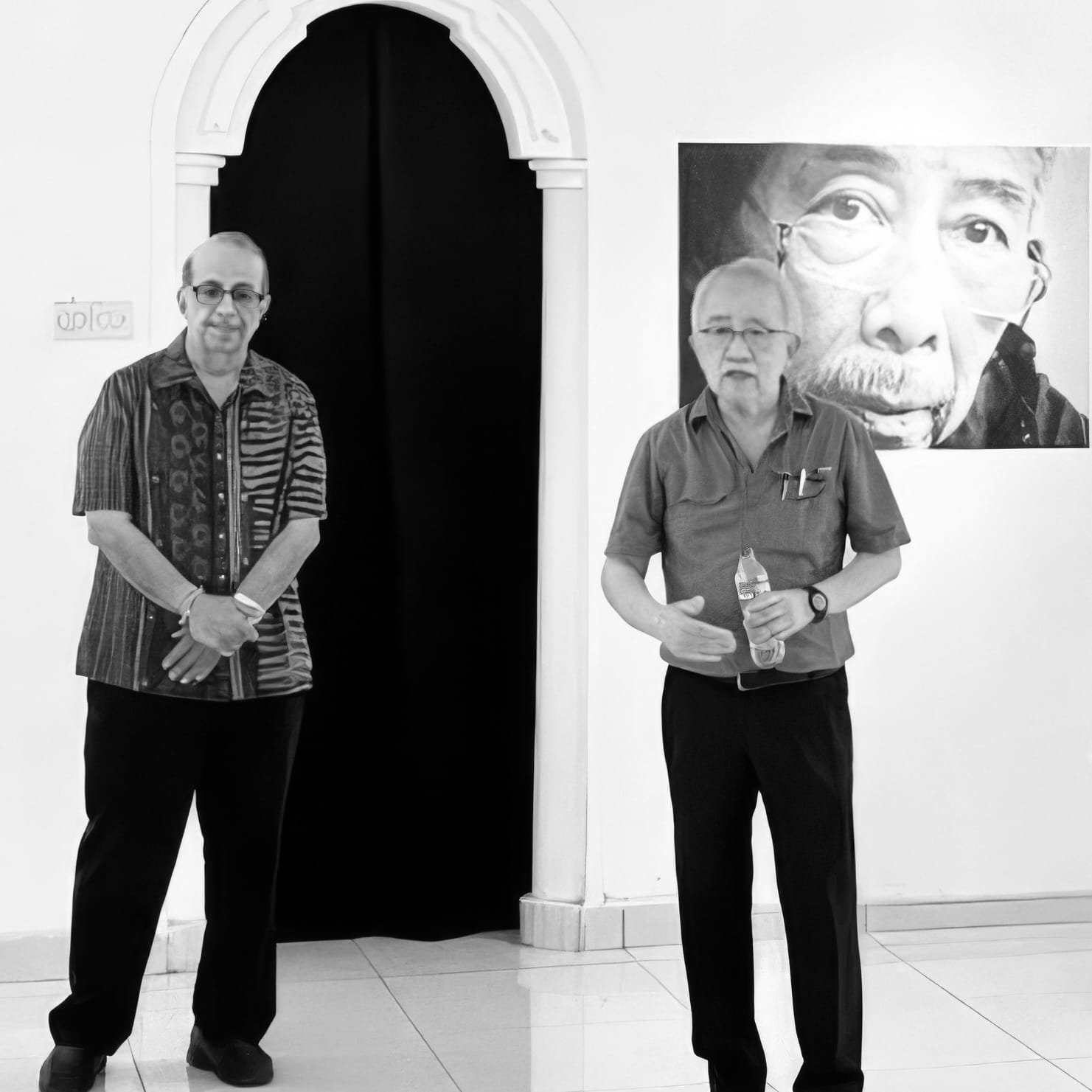
Launch day: Saturday, October 24, 2026
Read Part 2: When the sea remembers. Click here
Carolyn Khor is a contributing writer and researcher based in Penang who specialises in art, culture and heritage writing.